
By Bosphorus News Geopolitics Desk
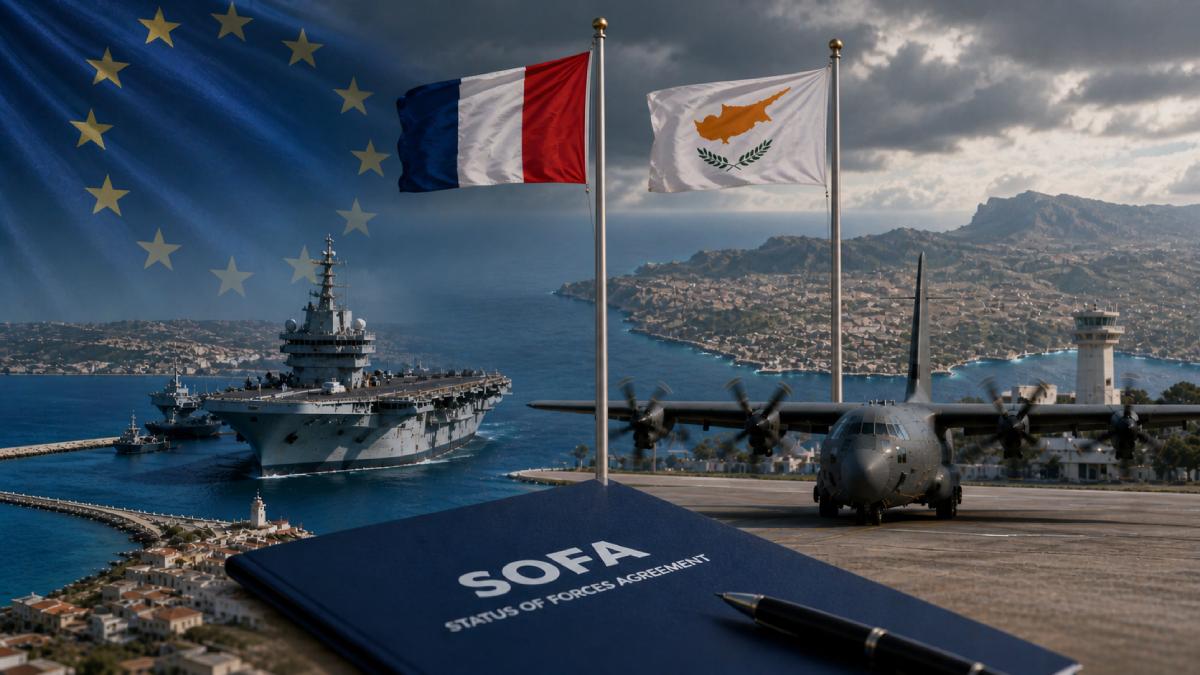
The Greek Cypriot administration and France have signed a Status of Forces Agreement that creates a legal framework for the presence and activities of French military personnel in Cyprus, turning a disputed defense file from warning into implementation.
The agreement was signed in Nicosia during an informal meeting of European Union defense ministers on June 7-8, where defense readiness, coordinated European responses and Common Security and Defense Policy priorities were on the agenda.
Greek Cypriot leader Nikos Christodoulides said the agreement had entered into force and linked it to the European Union's effort to strengthen strategic autonomy. Regional reporting said the agreement sets rules for French military personnel in Cyprus, including presence, movement and activities under agreed conditions.
The SOFA does not amount to a permanent French base. Its weight lies in the legal and practical space it gives to French military activity on an island where security authority, military access and the rights of the Turkish Cypriot side remain contested.
The Turkish Cypriot side had already rejected the agreement before the signing. In a May 5 statement, the TRNC Foreign Ministry said it was following the planned SOFA with "great concern," arguing that the Greek Cypriot administration had no authority to sign arrangements affecting the island as a whole.
The ministry said the agreement would enable the deployment of French military elements on the island, expand defense industry cooperation, support military technology sharing, deepen joint exercises and intensify high-level military dialogue. It also described the agreement as "null and void" for the Turkish Cypriot people.
The signing gives that dispute a new stage. A file presented by Nicosia and Paris as defense cooperation now carries operational rules, while the Turkish Cypriot side says one community is deepening military arrangements with a major European power without the consent of the other.
Bosphorus News previously framed the SOFA as part of a wider move turning Cyprus into a European security hub, where French military access, EU defense planning and Türkiye's guarantor role increasingly collide.
The June 8 signing also follows a more immediate warning track. A later Bosphorus News report said the expected agreement would move the Cyprus-France defense file from strategic language to operational rules, with Turkish Cypriot officials warning that the deal would alter the island's military balance.
The agreement follows a two-month diplomatic trail in which France's Cyprus and Greece messaging drew Turkish warnings, Turkish Cypriot objections and a later French clarification that President Emmanuel Macron's Athens remarks were not specifically aimed at Türkiye.
The timing adds to the sensitivity. The signing came during the same EU defense ministers' meeting cycle in Nicosia in which Türkiye rejected Greek claims over F-16 activity near Cyprus, saying Turkish jets had responded to violations of TRNC airspace and had not harassed ministerial aircraft.
The two files now sit side by side. One concerns French military personnel and legal access. The other concerns airspace, recognition and the contested authority of the Turkish Cypriot side. Together, they show how Cyprus is being pulled deeper into European defense planning while the island's political settlement remains unresolved.
The agreement also touches a wider question Bosphorus News has raised over Europe's defense bargain with Türkiye: how far the European Union can build new defense tools around Cyprus and Greece while keeping a major NATO ally at the edge of procurement, funding and political access.
The Cyprus-France SOFA now gives Paris and the Greek Cypriot administration a clearer legal channel for military cooperation. It also gives Türkiye and the Turkish Cypriot side a sharper example of how European defense policy can move through Cyprus without resolving the island's divided security order.
***Sources: Politis, Cyprus Mail, TRNC Foreign Ministry, Cyprus Presidency of the Council of the European Union and Bosphorus News reporting.