
By Bosphorus News Geopolitics Desk
Greece has opened a military investigation after an armed Ukrainian-origin sea drone was found near the Ionian island of Lefkada, a case Athens says raises serious questions for navigation security in the Mediterranean.
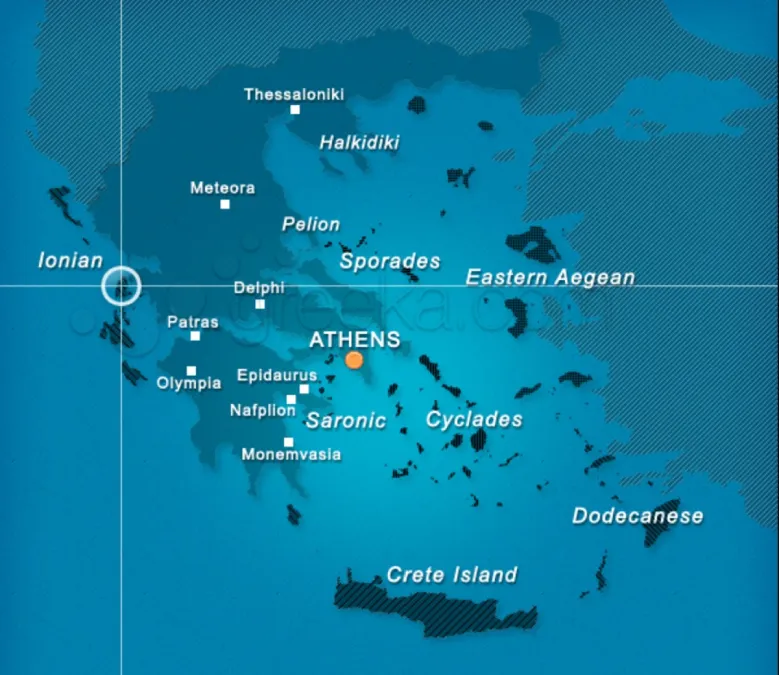
The unmanned surface vessel was found on May 7 near Cape Dukato, at the southern tip of Lefkada, and later transferred to a naval facility for examination. Greek officials have said the craft was armed, while Greek media and international reports have described it as resembling a Ukrainian Magura-type maritime drone.
Greek government spokesman Pavlos Marinakis confirmed on May 12 that the case was being examined by the Hellenic National Defence General Staff. He described the incident as a "particularly serious development" and said Greece would decide on any necessary diplomatic steps once the technical assessment was completed.
Marinakis also linked the case to a broader Greek concern that the Mediterranean should not become an extension of the war theatre. Athens is not treating the Lefkada drone simply as a stray military object, but as a warning about how Black Sea drone warfare can reach commercial and strategic maritime routes far from the main battlefield.
Greek Defence Minister Nikos Dendias raised the issue in Brussels as European Union defence ministers met on May 12. The Council of the European Union said the ministers discussed military support for Ukraine, defence readiness, threat assessments and the security impact of developments in the Middle East. Ukrainian Defence Minister Mykhailo Fedorov joined the meeting by video link.
Dendias said Greece now had certainty that the vessel was Ukrainian and described the case as extremely serious for freedom and safety of navigation. Greek reporting said he intended to raise the matter directly with his Ukrainian counterpart.
Dendias's intervention also gives the Lefkada case a wider deterrence context. Bosphorus News recently examined Greece's concern over a foreign naval drone linked to Ukraine and Türkiye's deterrence environment, as unmanned maritime systems move across theatres and force regional navies to monitor, identify and respond to platforms whose origin, mission and route may not be immediately clear.
The issue is no longer confined to Ukraine's use of naval drones against Russian assets in the Black Sea. Once such platforms appear near Greek waters, the debate shifts toward Mediterranean surveillance, coastal defence and the rules under which allied states handle weapons that may have drifted, malfunctioned or crossed into a different strategic space.
Kyiv has not confirmed the Greek claim. Ukraine's Foreign Ministry spokesman Heorhii Tykhyi said Ukraine had no information linking the vessel to Ukrainian maritime drone operators and had no evidence that it belonged to them. He also said Ukraine would be ready to cooperate if Greece made an official request.
That distinction is important. The current evidence supports a cautious formulation: Greece says the vessel was Ukrainian-origin, while Ukraine has not accepted responsibility or confirmed any operational link.
The drone's presence near Greek waters still gives the incident wider security value. Maritime drones have become one of the defining weapons of the Black Sea war, used to strike naval assets, ports and maritime infrastructure. Their movement, drift or loss outside the Black Sea would create a new layer of risk for Mediterranean shipping, coastal security and naval monitoring.
The Lefkada case also lands during a period of growing Greek-Ukrainian defence coordination. Bosphorus News previously reported on Greece's cooperation with Ukraine on naval drone production, a development that added a new dimension to Black Sea and Eastern Mediterranean security as maritime drone warfare became a more visible part of European defence planning.
Greece has not accused Ukraine of deliberately sending the drone toward Lefkada. The stronger point is different. Athens now has a concrete military object on its hands, found near a major Mediterranean island, and it is using the case to press a broader warning inside the European defence debate.
If the technical review confirms the drone's origin and payload, the incident will reinforce a problem European navies have been slow to absorb. Weapons developed for the Black Sea are now shaping how Mediterranean states think about surveillance, explosive ordnance, port protection and the protection of civilian navigation.
***Sources: Greek government briefing by spokesman Pavlos Marinakis, May 12, 2026. Council of the European Union, Foreign Affairs Council Defence, May 12, 2026. Statement by Greek National Defence Minister Nikos Dendias in Brussels, May 12, 2026. Associated Press. Ekathimerini. Ukrainian Pravda / European Pravda, statement by Ukrainian Foreign Ministry spokesman Heorhii Tykhyi, May 12, 2026 and Bosphorus News reporting.