
By Bosphorus News Geopolitics Desk
Two high-level diplomatic encounters between the United Arab Emirates and its Eastern Mediterranean partners took place within 48 hours of each other this week, as the Hormuz crisis continued to reshape the Gulf's political geometry and push regional actors to recalibrate their relationships with Abu Dhabi.
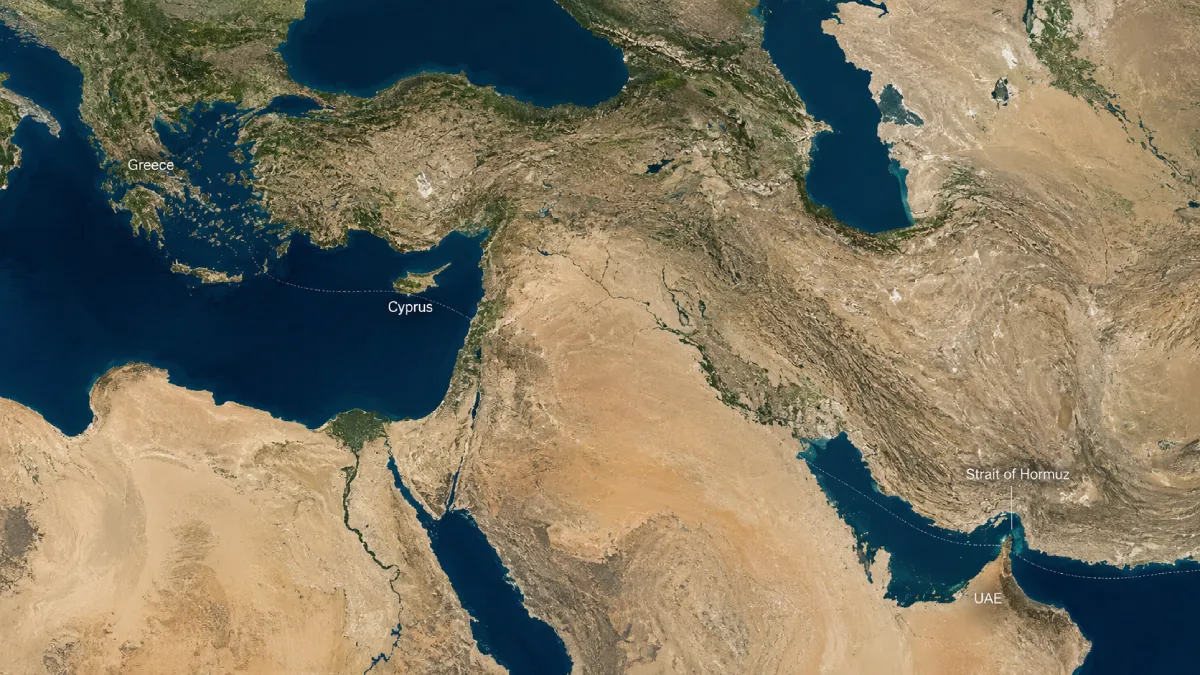
Greek Prime Minister Kyriakos Mitsotakis flew to Abu Dhabi on May 6, becoming the first European Union leader to visit the UAE following Iran's missile and drone strikes on Emirati civilian and oil infrastructure. He met UAE President Sheikh Mohamed bin Zayed Al Nahyan at a working session that covered bilateral cooperation, regional security and the principles governing international maritime trade. According to the Greek Prime Minister's office and UAE state news agency WAM, the two leaders signed a memorandum of understanding on artificial intelligence and technology cooperation and reaffirmed the framework of their Comprehensive Strategic Partnership, which marks its fiftieth anniversary this year.
Mitsotakis condemned the Iranian attacks and expressed Greece's solidarity with the UAE leadership. The two sides underscored their shared commitment to freedom of navigation under the United Nations Convention on the Law of the Sea, framing it as essential for international peace, supply chain security and economic prosperity. The Greek prime minister also called for a diplomatic resolution aimed at sustainable peace and stability across the region.
Two days later, on May 8, UAE Vice President Sheikh Mansour bin Zayed Al Nahyan arrived in Istanbul on a working visit and met President Recep Tayyip Erdoğan at the Dolmabahçe Working Office. Foreign Minister Hakan Fidan also attended. The UAE delegation was notably substantive: accompanying Sheikh Mansour were Sultan Al Jaber, Minister of Industry and Advanced Technology and Chief Executive of the Abu Dhabi National Oil Company; Mohamed Al Mazrouei, Minister of State for Defence Affairs; and Faisal Al Bannai, the UAE President's adviser for strategic research and advanced technology. Sheikh Mansour also visited SAHA 2026, the international defence and aerospace exhibition that concluded in Istanbul on May 8.
WAM described the talks as covering bilateral cooperation across economic, investment and security tracks, with the two sides reviewing ways to strengthen their relationship under the Comprehensive Economic Partnership Agreement signed between Türkiye and the UAE in 2023. Regional developments in the Middle East and their implications for security and stability were also discussed. The visit coincided with the conclusion of a defence agreement between Baykar and the UAE's EDGE Group, covering the integration of the Al Tariq precision-guided munition onto the Bayraktar Akıncı unmanned combat aerial vehicle.
The contrasts between the two encounters are as telling as the visits themselves. Mitsotakis went to Abu Dhabi, meeting the UAE President on Emirati soil and offering political solidarity to a country that had just absorbed Iranian strikes. He carried a diplomatic message grounded in international law, freedom of navigation and the EU's role as a partner in regional stability. The visit positioned Greece as a reliable ally at a moment of acute vulnerability for the Gulf.
Erdoğan received the UAE on his own terms, in Istanbul, during one of the largest defence industry exhibitions in the region's history. The presence of ADNOC's chief executive and the UAE's defence minister alongside Sheikh Mansour gave the meeting a concrete industrial and energy dimension that the Greek encounter, focused on political solidarity and a technology memorandum, did not carry in the same form. Türkiye and the UAE concluded a defence procurement agreement on the same day.
Both governments are pursuing the UAE for reasons that extend beyond the immediate crisis. Greece has spent the past several years repositioning itself as a security and connectivity hub in the Eastern Mediterranean, linking its EU membership, its geographic position and its deepening defence partnerships with Israel and Cyprus into a broader offer to Gulf partners seeking stable European entry points. Türkiye, which holds the second-largest military in NATO, a rapidly growing defence industry and a geographic position that sits between Europe, the Middle East and Central Asia, is pursuing a different track: deeper industrial and energy integration with Gulf capital at a moment when both sides benefit from diversifying their dependencies away from more volatile supply chains.
The Hormuz crisis has accelerated both strategies. With approximately a fifth of global oil and liquefied natural gas exports disrupted and European energy markets under sustained pressure, the UAE's relationships with its Eastern Mediterranean partners carry direct economic weight. Greece, as a major shipping nation and EU member, offers access to European markets and maritime law frameworks. Türkiye, as a defence exporter and energy transit hub, offers a different set of assets.
Abu Dhabi appears to have concluded that both are worth cultivating simultaneously.
Sources: UAE state news agency WAM, May 6 and May 8, 2026. Greek Prime Minister's office statement, May 6, 2026. Athens Times, New Greek TV, Gulf Today. Daily Sabah, Yeni Şafak, The National. Baykar and EDGE Group announcement, SAHA 2026, May 8, 2026.