
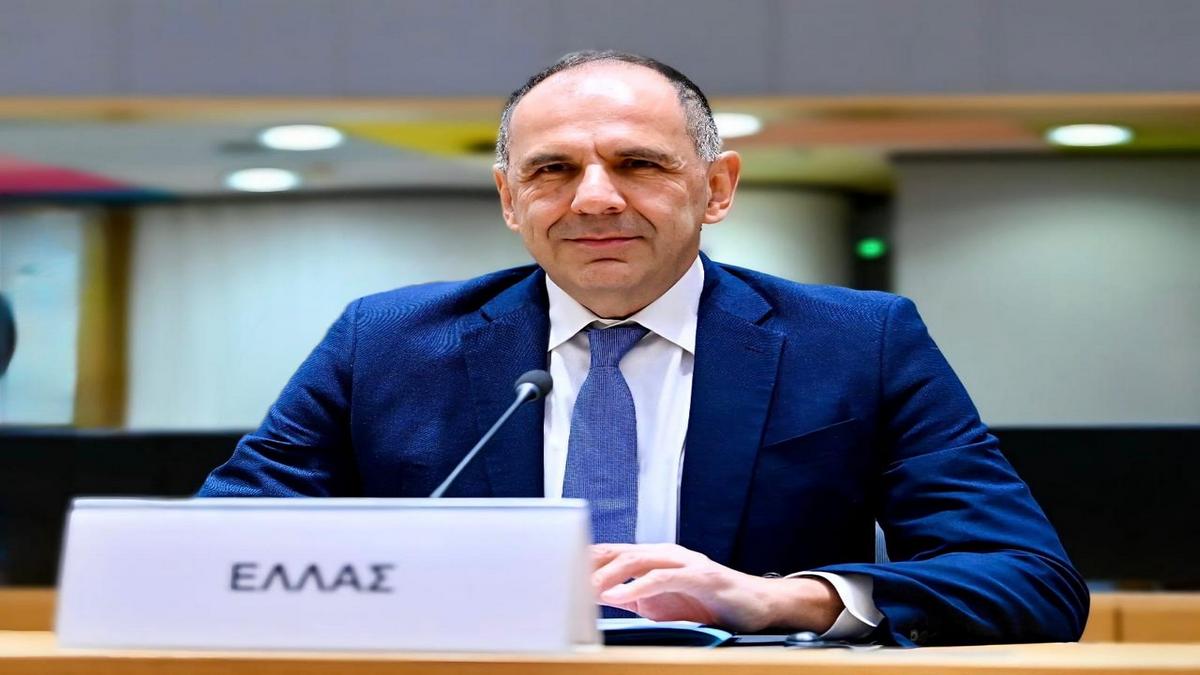
Greece's Foreign Minister Giorgos Gerapetritis said Athens treats sovereignty as non-negotiable in its relations with Türkiye, while keeping diplomatic channels open through what he described as a structured dialogue.
In an interview published by the Hellenic Ministry of Foreign Affairs, Gerapetritis outlined Greece's positions on Türkiye, regional security, and broader international issues, drawing a clear distinction between dialogue and questions of sovereign rights.
Territorial waters
Gerapetritis said Greece's right to extend its territorial waters up to 12 nautical miles is not subject to negotiation.
"The extension of territorial waters up to 12 nautical miles is an inalienable right of Greece," he said, adding that "the exercise of a lawful right cannot and should not provoke a crisis between two neighbouring countries."
He stressed that sovereignty-related matters are excluded from bilateral talks.
"We are discussing with Türkiye within the framework of a structured dialogue that began about two years ago," Gerapetritis said. "However, issues of sovereignty are not part of this dialogue."
Maritime jurisdiction
Gerapetritis reiterated that Athens recognises only one issue with Türkiye that could be referred to an international legal process.
"The only dispute that could be brought before an international procedure is the delimitation of the exclusive economic zone and the continental shelf," he said.
The statement reflects Greece's position that other matters raised by Ankara do not constitute legally recognised disputes under international law.
Dialogue and limits
Responding to suggestions that engagement could imply compromise, the Greek foreign minister rejected that framing.
"Dialogue does not mean retreat," he said. "Dialogue is the mechanism that prevents tension and miscalculation."
Structural frictions
While Gerapetritis underlined the importance of open channels and a structured dialogue with Türkiye, his remarks also came against a backdrop of persistent frictions that continue to shape bilateral ties. Disputes over the militarisation and armament of Greek islands, an expanding pattern of reciprocal defence procurement, and Athens' decision to raise these issues at the highest political level, despite Türkiye's long-standing casus belli resolution adopted by the Turkish parliament (which defines a unilateral extension of Greek territorial waters in the Aegean beyond six nautical miles as grounds for war), point to a relationship that remains structurally tense rather than settled.
The remarks therefore carry added weight ahead of a planned meeting next month between Greek Prime Minister Kyriakos Mitsotakis and Turkish President Recep Tayyip Erdoğan, which both sides have publicly confirmed. In that context, Gerapetritis' emphasis on dialogue coexists with signals that core security disagreements continue to frame the bilateral agenda.
Regional and alliance context
Beyond bilateral relations, Gerapetritis placed Greece's policy toward Türkiye within a wider regional setting that includes the Balkans, the Eastern Mediterranean, and ongoing conflicts in Syria and Gaza. He said Greece supports initiatives aimed at reducing regional polarisation and managing instability through multilateral coordination.
On Gaza, he referred to de-escalation efforts and humanitarian access, while underlining Greece's commitment to international law.
Gerapetritis also referred to NATO cohesion and the war in Ukraine, arguing that respect for sovereignty and territorial integrity must be applied consistently across regions, including the Eastern Mediterranean.
The interview outlines Athens' current diplomatic posture toward Türkiye. Dialogue remains the preferred channel, but it operates within clearly defined limits shaped by unresolved security and sovereignty disputes.