
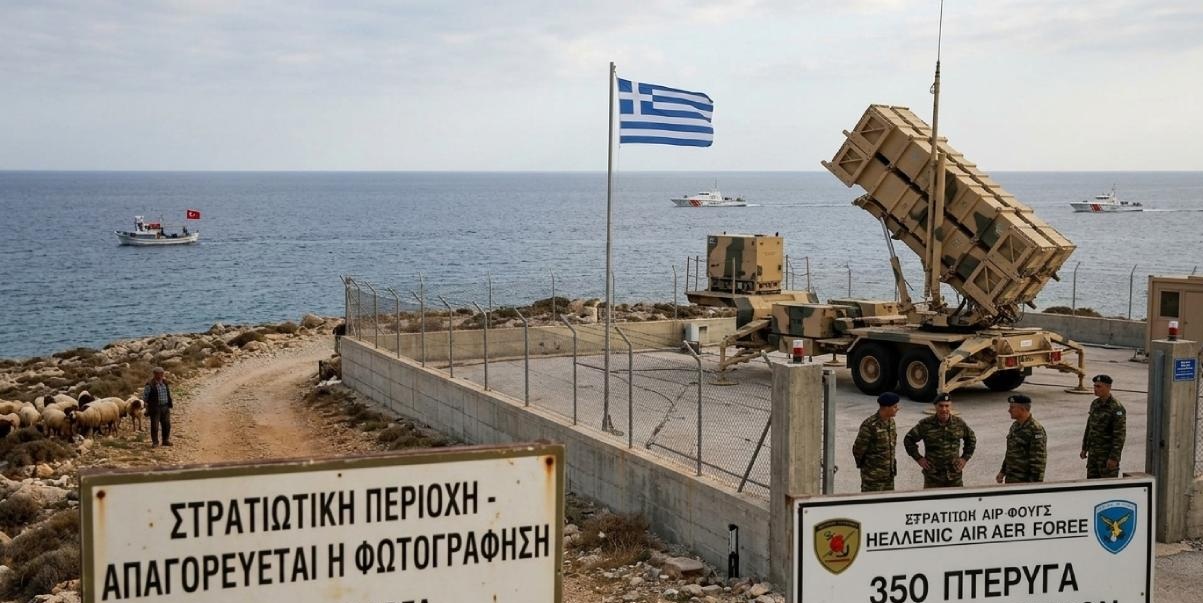
Athens says the Patriot battery is part of an air-defence redeployment. Ankara frames the move through the "demilitarised status" argument in the Aegean.
Greece confirmed the deployment of a Patriot air-defence battery to the island of Karpathos on March 3, presenting the move as part of a wider redeployment of the country's air-defence posture. The Greek Foreign Ministry spokesperson described it as a precautionary measure taken within the framework of national air-defence restructuring.
Türkiye's Foreign Ministry responded on March 5 with a formal protest, reiterating Ankara's position that the status of the Eastern Aegean islands and the Dodecanese is defined by international treaties and is not open to reinterpretation. The statement argued that the non-militarised status of the islands is grounded in the 1923 Treaty of Lausanne and the 1947 Paris Peace Treaty, and criticised what it described as attempts to exploit regional instability to create faits accomplis.
Athens rejected the protest the same day. The Greek Foreign Ministry said Türkiye's claims regarding the demilitarised status of the islands are unfounded and have been repeatedly rejected in the past. Greece reaffirmed that the legal status of the Eastern Aegean and Dodecanese islands is settled by three international agreements: the 1923 Treaty of Lausanne, the 1936 Montreux Convention, and the 1947 Treaty of Paris. It also noted that Türkiye is not a signatory to the 1947 Treaty of Paris, which ceded the Dodecanese to Greece, and therefore has no legal standing to invoke it. Greece's defensive arrangements, the ministry said, are non-negotiable.
The dispute over the militarisation of Aegean islands is not new. Türkiye has raised the demilitarised status argument consistently for decades, treating it as a structural constraint on Greek sovereignty in the islands. Greece has consistently rejected that reading, arguing that the right to self-defence under international law supersedes treaty-era restrictions and that successive international agreements confirm its position. Neither side has shifted its legal interpretation, and each new deployment tends to reopen the same exchange.
The current episode is taking place against a backdrop of acute regional instability. Ongoing conflict involving Israel, the United States and Iran has altered the air-defence calculus across the Eastern Mediterranean. Athens has framed the Karpathos deployment explicitly in this context, describing regional war-like conditions as the operational rationale. That framing adds a layer of complexity to Türkiye's protest: Ankara is challenging a deployment that Greece has justified on collective security grounds, within an alliance both countries share.
The exchange is the latest episode in a long-running dispute over treaty interpretation in the Aegean. Both sides treat the file as a sovereignty issue, not a narrow technical argument about deployments.