
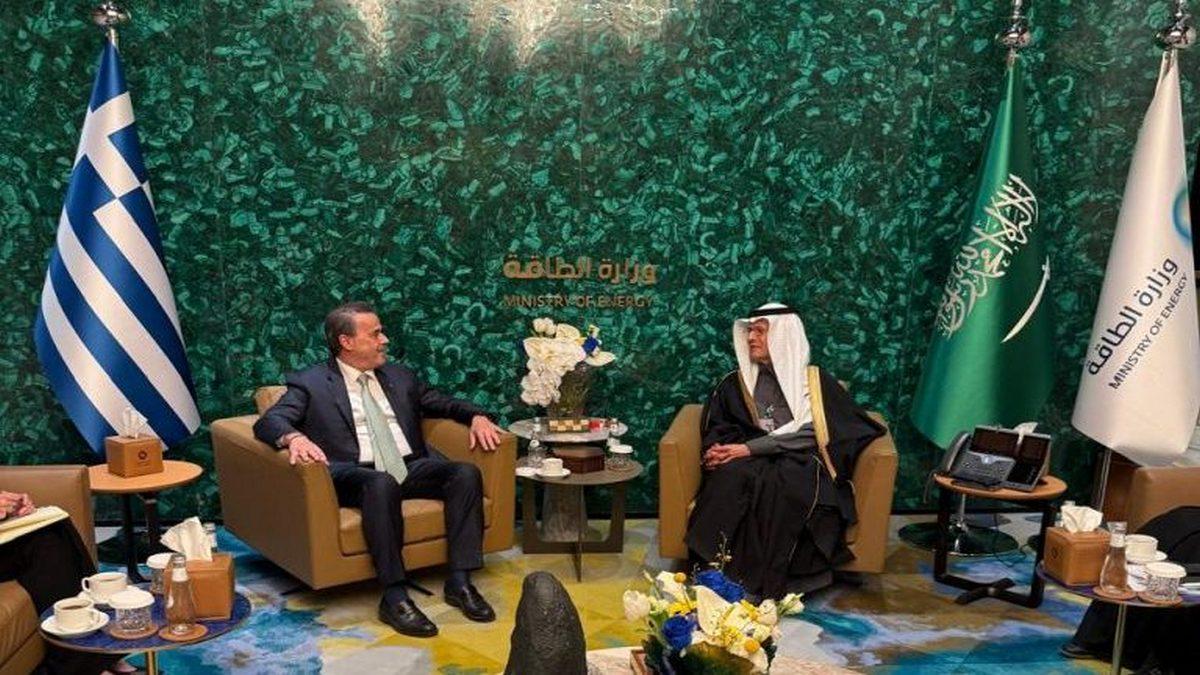
Greece and Saudi Arabia have intensified discussions on closer energy cooperation, with Athens promoting a framework that would channel Saudi energy production and investment toward European markets through Greek-controlled routes, according to recent reporting and official briefings.
The latest round of talks took place in Riyadh on 15 January 2026, where Greece's Minister of Environment and Energy Stavros Papastavrou met Saudi Energy Minister Prince Abdulaziz bin Salman. The meetings covered energy cooperation, connectivity projects and infrastructure planning, with a focus on electricity interconnection concepts and renewable energy initiatives.
Greek officials have framed these discussions as part of a broader vision to position Greece as a gateway linking the Middle East to Europe. No binding agreements have been announced, and the proposals remain at a preparatory stage.
The corridor narrative builds on earlier exchanges between Athens and Riyadh, including discussions over energy infrastructure, clean technology cooperation and Saudi investment interest in Greece. In recent months, Athens has increasingly packaged these contacts as part of a wider effort to present itself as a regional hub for electricity, data and transport links connecting the Middle East to European markets.
Notably, the projects and routes highlighted in Greek briefings point to a recurring preference for connectivity schemes designed outside Türkiye's transit geography. This reflects a longer-standing pattern in Greek energy diplomacy, where hub ambitions are tied to alternatives that reframe regional flows toward Greek-controlled entry points, even as commercial, regulatory and grid constraints remain unresolved.
This approach has also placed Greece at odds with the EU majority. Athens has aligned with the United States and Saudi Arabia in opposing stricter climate-neutral shipping rules at the International Maritime Organization, diverging from positions supported by most EU member states and signalling a readiness to prioritise strategic alignment over internal EU consensus.
For now, the Greece–Saudi Arabia energy corridor remains a strategic concept rather than a defined infrastructure project. What the current push makes clear is Athens' intent to use energy and connectivity diplomacy to redraw regional routes and standards in ways that place Greece at the centre of future Middle East–Europe links while structurally keeping Türkiye outside the core design.