
By Bosphorus News Geopolitics Desk
Greek Defence Minister Nikos Dendias said Greek aircraft and support teams reached Cyprus' Andreas Papandreou Airbase within hours of an order to cover the Republic of Cyprus' airspace against threats from Iran, placing the March deployment inside a broader European solidarity framework.
Speaking at DEFEA Conference 2026 in Athens on May 5, Dendias said the Hellenic Air Force was ordered at noon to cover Cypriot airspace and that Greek aircraft were already at the Paphos airbase by 7 p.m. He said the same order went to the Hellenic Navy, with Greek frigates sailing for the Eastern Mediterranean by 10:30 p.m., according to the Greek Defence Ministry transcript.
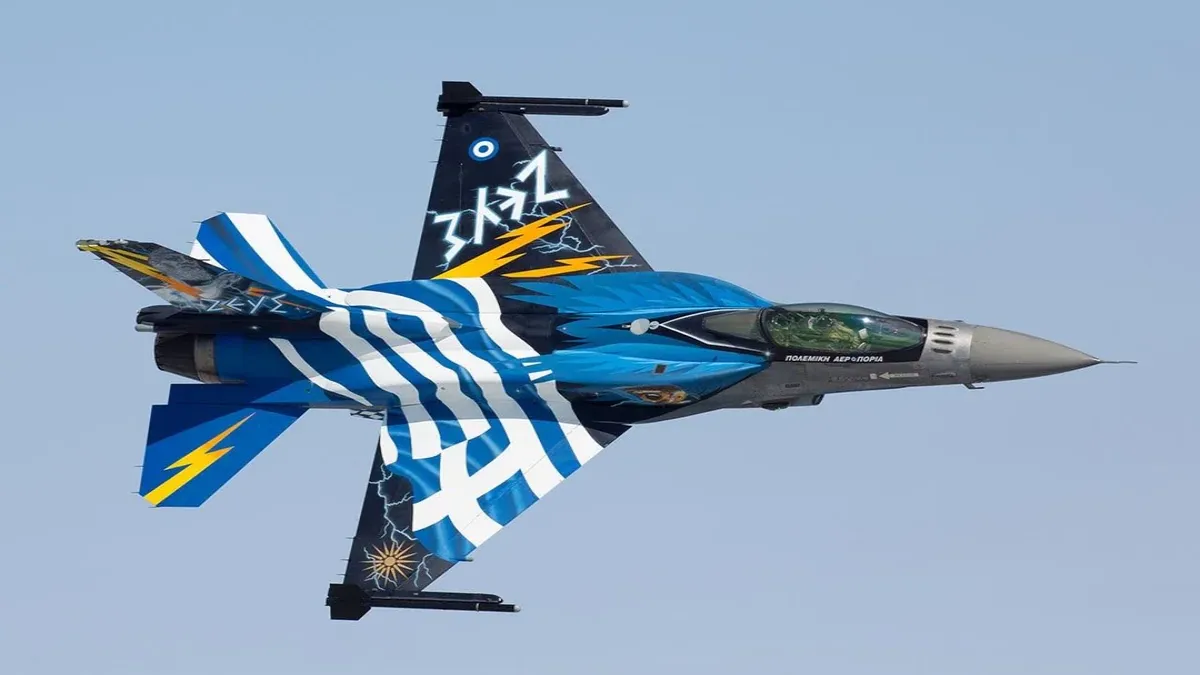
The comments provided a detailed operational timeline for Greece's March deployment to Cyprus, when Athens sent two pairs of F-16 fighter aircraft and two frigates after a Shahed drone struck the British RAF Akrotiri base and European governments moved to reinforce the island.
Dendias presented the deployment as a test of speed for the Hellenic Armed Forces, saying Greece had acquired "speed and agility" that had not previously existed at that level. His comments also moved the episode beyond a narrow bilateral Greece-Cyprus frame, tying the response to the European Union's mutual assistance clause.
Asked whether the deployment amounted to a de facto application of Article 42.7 of the Treaty on European Union, Dendias replied: "Obviously. Obviously." He said Greece had acted within an institutional framework of European solidarity, while also pointing to the close national relationship between Greece and Cyprus.
The March deployment had already been described by Athens as both a national and European obligation. During a visit to Cyprus on March 3, Dendias said two pairs of F-16s were already on the island and two Hellenic Navy frigates were sailing toward Cyprus following a decision by Greece's Governmental Council for National Security.
One of those vessels, the frigate PSARA, was equipped with the Greek-produced Centaur anti-UAV system, which Athens said had been tested in the EU's ASPIDES operation in the Red Sea. The second vessel, KIMON, was described by Dendias as Greece's most modern frigate. He also visited Andreas Papandreou Airbase in Paphos, where the F-16s had landed.
Reuters reported in March that Britain, France and Greece sent air-defence forces to Cyprus after the Akrotiri strike, while Greece deployed four F-16s and two frigates. AP separately reported that European states rallied around Cyprus as the island became a forward security point during the crisis, with French President Emmanuel Macron saying that "When Cyprus is attacked, it is Europe that is attacked."
Dendias rejected the idea that Greece was building an ad hoc anti-Türkiye coalition, but his remarks placed Cyprus more firmly inside Greece's European and regional defence planning. He said Athens was not pursuing a "turco-centric" policy, while keeping Greece's longstanding position on Cyprus unchanged.
Dendias presented the immediate trigger as Iran-related and rejected the idea that Greece was creating an ad hoc anti-Türkiye coalition. The operational effect was still wider: Greek aircraft were deployed to a Cypriot airbase, Greek frigates moved toward the Eastern Mediterranean and Athens described the move through the language of EU solidarity.
The remarks add a sharper operational layer to the defence alignment around Cyprus, where Greece, Cyprus and Israel have already moved to deepen military coordination across the Eastern Mediterranean. Bosphorus News previously detailed how the Greece-Cyprus-Israel trilateral military pact is reinforcing a wider security architecture around the island.
The timing also placed the Cyprus discussion inside a larger European defence debate. NATO said Deputy Secretary General Radmila Shekerinska visited Athens on May 5 to stress the need for a stronger defence industry and a "stronger Europe within a stronger NATO," as allied governments look toward the Ankara NATO Summit and rising pressure to increase production capacity.
At DEFEA, Dendias met Cypriot President Nikos Christodoulides and Shekerinska on the margins of the conference. The setting brought the Cyprus deployment discussion into the same venue as broader debates on EU solidarity, Greek military readiness and NATO's push for stronger European defence production.
The episode has placed Andreas Papandreou Airbase and Cyprus' surrounding waters more visibly inside Greece's regional response planning, at a time when European governments are debating how to defend EU territory from drone and missile threats.