
By Bosphorus News Staff
Five Arrests in Nine Months
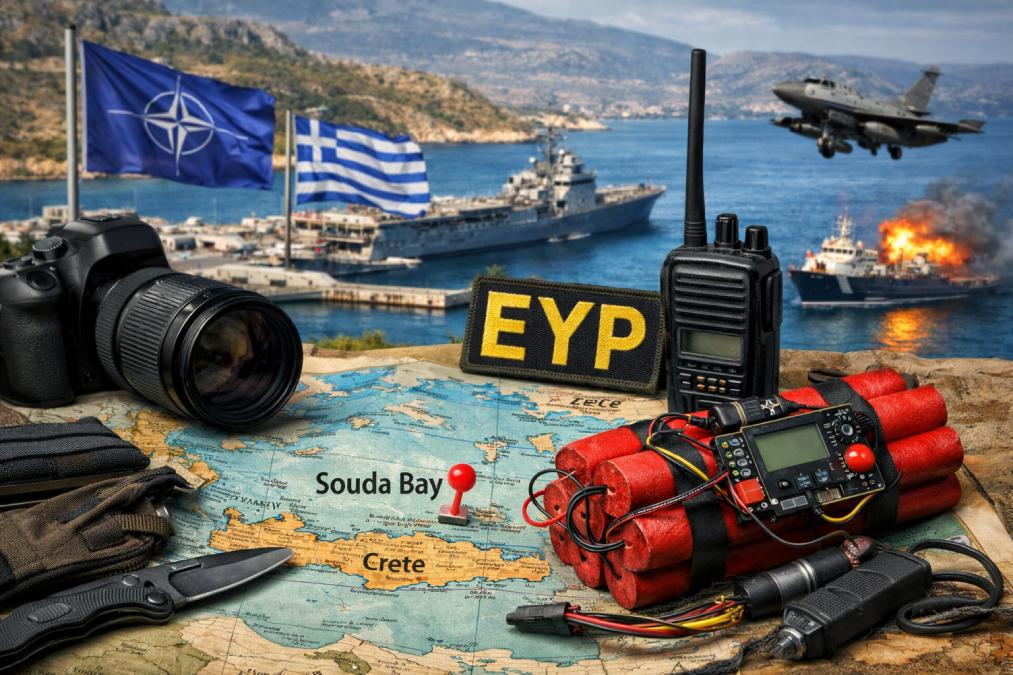
Greek authorities have arrested five people on espionage and sabotage charges since June 2025, all tied to NATO military assets. Three cases involve the Souda Bay naval base in Crete, which hosts U.S. and NATO forces. The other two involve a Greek Air Force colonel who passed classified NATO information to China, and a Greek port worker who sabotaged German Navy warships in Hamburg.
Souda Bay: Three Suspects in Ten Days
The most recent arrest came on March 12, when Greek police detained a 58-year-old Polish national who had been living in a caravan in Marathi, a village near the base, for two months. Authorities found photographs of warships entering the harbour on his mobile phone and seized additional electronic devices. He denies the charges. Greece's National Intelligence Service, the EYP, had placed him under surveillance before his arrest.
Ten days earlier, on March 2, a 36-year-old Georgian national of Azerbaijani origin was arrested at Athens airport after EYP tracked him from Crete. He had arrived in Greece on February 3, flying in from Düsseldorf, and stayed in hotels with direct views of the base. Photographs of the USS Gerald R. Ford, the U.S. Navy's nuclear-powered aircraft carrier that docked at Souda Bay from February 23 to 26 before sailing to the Eastern Mediterranean, were found on his phone. Greek authorities are investigating possible links to Iran. He was convicted of illegal entry and sentenced to two years; the espionage investigation is ongoing.
The first Souda Bay arrest came on June 23, 2025, when a 26-year-old man holding a Polish passport and identified as an Azerbaijani citizen of Iranian descent was detained on Crete for photographing military installations and naval movements at the base. He remains in pre-trial custody. Investigators are examining whether the June 2025 suspect and the March 2026 Georgian national are connected, noting that both stayed at the same hotel near the base.
Greek Foreign Minister George Gerapetritis moved to reassure the public after the March 2 arrest. "Greek citizens can feel secure," he stated, adding that the base's role is strictly logistical, governed by a pre-existing defence agreement between Greece and the United States.
Greek Air Force Colonel Arrested for Spying for China
On February 5, Greek military authorities arrested Colonel Christos Flessas, 54, inside his base in Kavouri, near Athens, on espionage charges. Flessas commanded the 128th Telecommunications and Electronics Training Squadron and held NATO accreditation as a communications specialist for a decade. He had been involved in the modernisation of Patriot air defence systems and had inspected military bases across Europe in that capacity.
The CIA alerted Greece's EYP roughly four months before the arrest that a member of the Greek armed forces was leaking classified NATO information to China. EYP monitored Flessas before military authorities moved to detain him.
In an eight-hour hearing before the Athens Military Court on February 11, Flessas confessed. Speaking through his lawyer, he said: "Unknowingly and without intent, I became involved in something that developed in a way that became nightmarish, dangerous and illegal." He said he was first approached via social media by someone using the alias "Steven Wayne" during a private trip to China in 2024, was paid through a cryptocurrency wallet, and named his handler and two others who presented themselves as corporate executives. On February 12, the court remanded him in pre-trial custody. If convicted, he faces a potential life sentence. Under a law enacted last year, a final conviction for espionage can also result in revocation of Greek citizenship.
French authorities arrested four individuals in Gironde on February 4, including two Chinese nationals accused of harvesting Starlink satellite data and intelligence from military installations. Greek investigators are examining whether that network and the Flessas case are connected.
Greek Worker Arrested for Sabotaging German Navy Warships
On February 3, a 54-year-old Greek national was arrested in a dawn raid at his home in the village of Koptero in Rodopi, northeastern Greece, under a European Arrest Warrant issued by German authorities. A 37-year-old Romanian national was arrested the same day in Hamburg. The operation was coordinated by Eurojust, the EU's criminal justice cooperation agency.
Both men had worked as port employees at the Blohm+Voss shipyard in Hamburg, where several K130-class corvettes, small warships, were under construction or maintenance for the German Navy. Investigators say the two men used their legitimate access to carry out at least seven acts of sabotage across five vessels in 2025. On the corvette Emden, they dumped more than 20 kilograms of abrasive gravel into the engine block, punctured freshwater supply lines, removed fuel tank caps, and deactivated electronic safety switches. The sabotage was discovered during a routine pre-departure inspection in mid-January 2025, before the Emden's first voyage to Kiel.
Eurojust said in a statement: "If gone undetected, the acts would have caused major damage to the ships and delayed their departure, endangering the operations of the German Navy." Homes in Germany, Greece, and Romania were searched simultaneously, with digital devices, bank documents, and cash seized. No motive has been confirmed. Investigators are still determining whether the two men acted alone or were directed by a foreign power.
A Pattern Greek Authorities Cannot Ignore
The five cases share no confirmed operational link, and Greek authorities have not publicly connected them. All five arrests became public within a six-week window, between early February and mid-March 2026, as the U.S.-Israeli military campaign against Iran, which began on February 28, brought heightened attention to NATO assets in the Eastern Mediterranean.
The USS Gerald R. Ford passed through Souda Bay days before the strikes on Iran. Security measures at critical sites across Greece have been reinforced since the conflict began.
The Hamburg sabotage and the Flessas case involve different alleged sponsors and different types of threat. German prosecutors have not confirmed a foreign power directed the shipyard workers. Greek investigators have not closed that question either.
Bosphorus News reported on this pattern as early as February 7, when a series of counter-espionage operations across the region were still unfolding simultaneously. That report covered Türkiye's detention of suspects accused of spying for Mossad and the IRGC, the attempted sabotage of German Navy vessels, the arrest of the Greek Air Force officer, the deaths of two Russian nationals in Cyprus under unexplained circumstances, and the killing of a senior Russian military commander in Moscow. No official has drawn a line between them.