
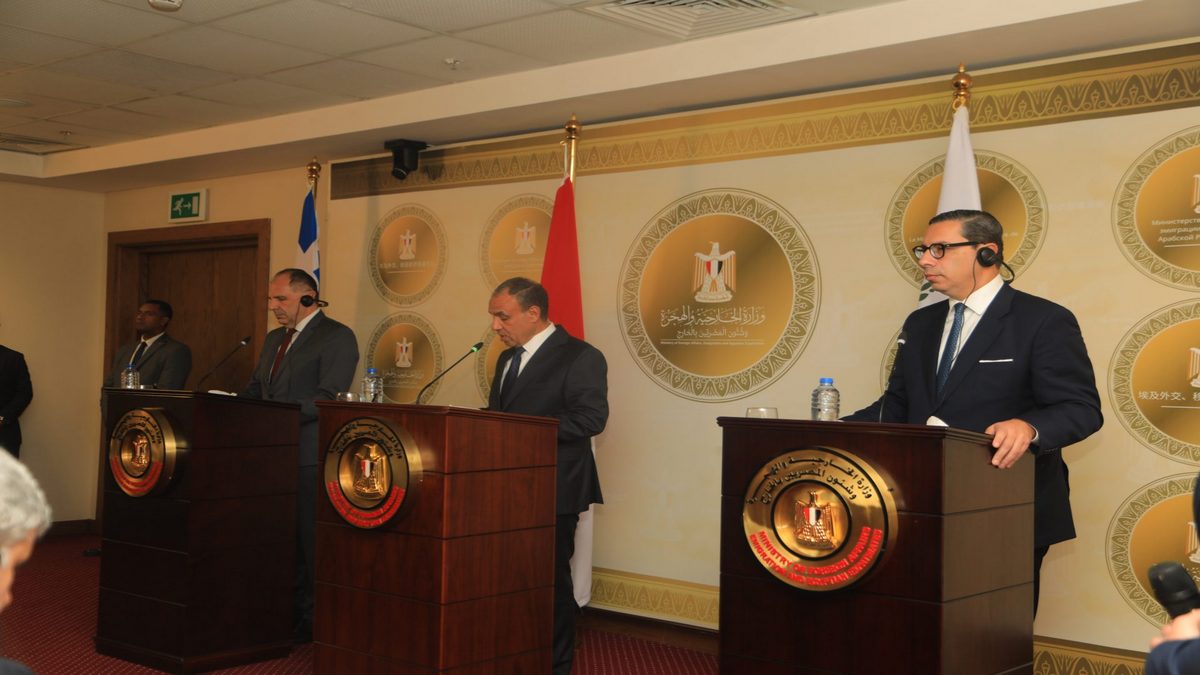
The foreign ministers of Greece, Egypt and Cyprus met in Cairo on 18 January 2026 for trilateral talks centred on regional crises, coordination in international fora and the next phase of their cooperation framework.
Ahead of the trilateral session, Greek Foreign Minister George Gerapetritis held bilateral talks with his Egyptian counterpart Badr Abdelatty. According to Greece's foreign ministry, the two sides reviewed the Greece–Egypt strategic partnership and exchanged views on regional developments, including Gaza, Libya and Sudan.
The Cairo agenda brought together files that directly intersect with Türkiye's immediate neighbourhood, notably Libya, Gaza, Syria and broader Eastern Mediterranean dynamics.
What the trilateral format is being used for
In its official statement, Greece presented the trilateral format as a vehicle for sustained coordination on regional developments and cooperation across economic and energy related areas, with repeated reference to international law and diplomatic engagement.
Egypt's foreign ministry, in its own readout, described the meeting as part of an established tripartite mechanism intended to align positions on regional crises and advance cooperation in sectors such as energy and connectivity.
From declarations to implementation
Cypriot Foreign Minister Constantinos Kombos said the discussions focused on bilateral relations and on ensuring full implementation of commitments taken at last year's summit. He added that the three sides examined practical steps forward, including a mechanism to monitor progress.
Kombos characterised the trilateral relationship as grounded in public international law, geography and historical ties, and stressed the importance of coordination on regional crises, citing Syria, Sudan, Yemen, Libya, Gaza and Iran.
Cyprus's EU role and Egypt's regional weight
Kombos also referred to Cyprus assuming the Presidency of the Council of the European Union, saying Nicosia intends to strengthen links between the EU and the Eastern Mediterranean. He highlighted Egypt's role for European security, including on migration, and said Cyprus would support Cairo's position in Brussels regarding equitable support.
On Gaza, Kombos reiterated Cyprus's support for a two state solution and recalled Cyprus's recognition of Palestinian self determination in 1988. He also raised concerns over developments in Iran and Syria, underlining the need for de escalation, diplomacy and the protection of minorities.
Cyprus issue and alignment principles
Kombos further said he briefed his counterparts on the Cyprus issue and thanked Greece and Egypt for what he described as their principled support for a settlement framework based on international law and UN Security Council resolutions.
Coordinated diplomacy led by Athens and Nicosia
Ankara assesses that Greece and Cyprus are acting in close coordination and, in line with this approach, are engaging with regional actors such as Israel and Egypt in ways that run counter to Türkiye's interests. Turkish officials describe these moves not as isolated initiatives, but as a coordinated diplomatic posture shaped in Athens and Nicosia and projected through multiple regional partnerships.
Senior Turkish officials say this pattern is being closely monitored. Foreign Minister Hakan Fidan has stated publicly that Ankara prioritises diplomacy, but warned that sustained alignment against Türkiye would lead to firmer responses if diplomatic tools fail. He said Türkiye develops diplomatic countermeasures first, adding that unresolved issues are then transferred to the security domain.
"Visible areas of encirclement are alliance structures formed against Türkiye's interests. There are alliance formations being constructed in the Mediterranean and the Eastern Mediterranean. We see them, and we develop diplomatic measures in response. If diplomatic measures are not developed on certain issues, the matter is then transferred to the military, to the security institutions, and further steps follow."
From Ankara's perspective, the issue is not dialogue among regional actors, but the direction and intent of that coordination. As diplomatic tracks multiply across the Eastern Mediterranean, Turkish officials indicate that their assessment will hinge on whether these processes reduce regional frictions or consolidate exclusionary alignments. That judgment, they say, will shape Türkiye's next steps.