
By Bosphorus News Geopolitics Desk
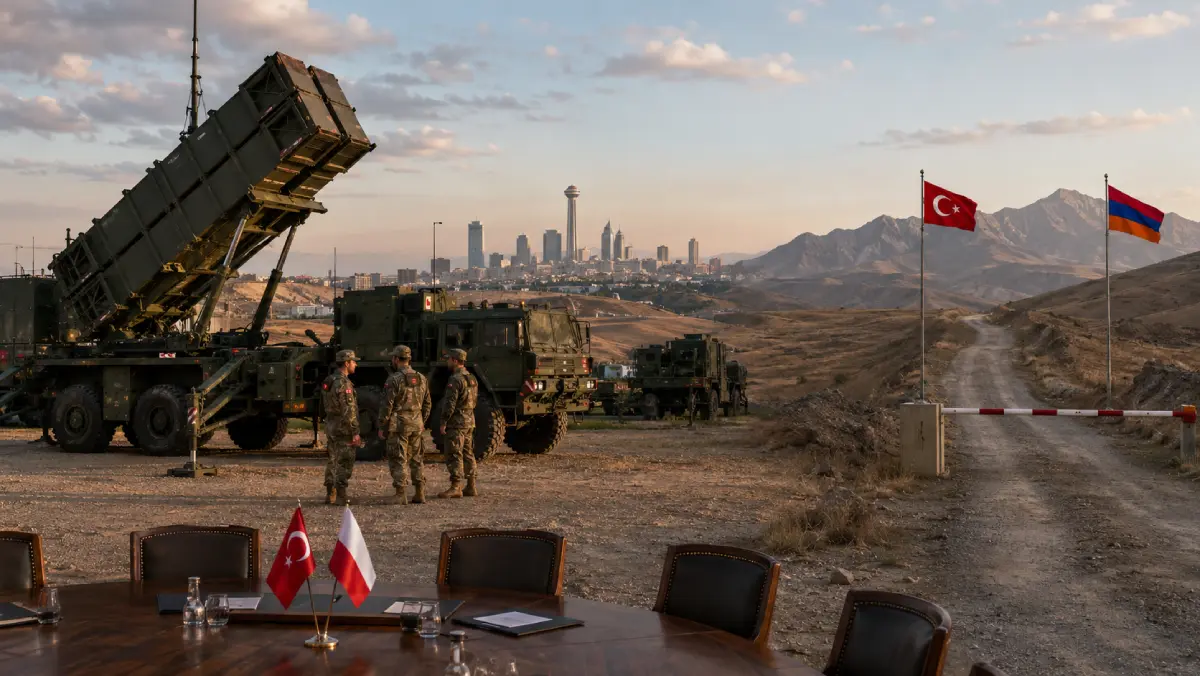
Germany will deploy a Patriot air-defence battery and around 150 soldiers to Türkiye from late June to September 2026, reinforcing NATO's southeastern flank weeks before the alliance holds its July 7-8 summit in Ankara.
The deployment, confirmed by German defence authorities and reported by defence outlets, will replace a U.S. unit and operate under NATO's Integrated Air and Missile Defence framework in coordination with the Turkish Armed Forces. The unit is expected to come from Flugabwehrraketengeschwader 1, Germany's air-defence missile wing based in Husum.
German Defence Minister Boris Pistorius framed the move as part of Berlin's larger NATO burden-sharing role.
"Germany is taking on more responsibility within NATO," Pistorius said, according to reports citing the German Defence Ministry.
The deployment gives the Ankara Summit a sharper military backdrop. Türkiye is not only hosting NATO leaders in July. It is also becoming a live air-defence node for the alliance at a time when the Eastern Mediterranean, the Black Sea and the Middle East remain connected through missile risk, drone warfare, energy security and regional deterrence.
The mission also recalls NATO's earlier Patriot presence in Türkiye. Germany previously deployed Patriot systems to Türkiye under Operation Active Fence between 2013 and 2015, when NATO moved air-defence assets to protect Türkiye against spillover from the Syrian war. The new mission comes in a different regional environment, but the underlying logic is familiar: Türkiye's geography turns alliance security into a practical military task, not an abstract planning document.
Azerbaijan Sets Public Conditions on the Armenia Border
A separate South Caucasus file is moving at the same time. Türkiye recently lifted restrictions on direct trade with Armenia, a symbolic step in a normalisation process that has moved slowly since Ankara and Yerevan appointed special envoys in 2021.
The more delicate development came from Azerbaijan. Rashad Mammadov, Azerbaijan's ambassador to Türkiye, said the Türkiye-Armenia border would open after Armenia's June 7 election and constitutional changes, according to Turkish and regional reports. His comments linked the border file to Azerbaijani demands that Armenia remove what Baku describes as territorial claims from its constitution.
That matters because Ankara has not announced such a firm timetable. Türkiye's Foreign Ministry has previously said there was no fixed calendar for opening the border. Mammadov's remarks therefore put Azerbaijan's reading of the process ahead of Ankara's official public line.
The point was captured sharply by Gönül Tol, director of the Turkey programme at the Middle East Institute, who described the Azerbaijani ambassador's public statement on when and under what conditions Türkiye would open the border as "a new level," according to Turkish Minute.
The border file is not a side issue for Türkiye's regional role. Opening the Türkiye-Armenia frontier would affect trade routes, South Caucasus connectivity, Azerbaijan-Armenia normalisation and the wider corridor politics linking Türkiye to the Caspian basin and Central Asia. But the latest remarks also show that Ankara's room for manoeuvre remains closely tied to Baku's conditions.
Poland Adds a European NATO Layer
Poland has added another European layer to the same NATO picture. Polish Deputy Foreign Minister Marcin Bosacki described Türkiye as a key strategic partner, pointing to defence, security and economic cooperation, while also recalling the earlier $15 billion bilateral trade target set during Donald Tusk's 2025 visit to Ankara.
The figure is not a new pledge, but Warsaw's renewed language matters. Poland looks at Türkiye through the Black Sea, NATO's eastern flank and Europe's defence industry debate, while Türkiye increasingly sits across several security maps at once: NATO's southeastern flank, the South Caucasus, the Black Sea and the alliance's industrial capacity problem.
Poland's language also fits a wider European debate over how security, enlargement and industrial capacity are being reorganised around the EU's eastern and southeastern neighbourhoods. That debate has already reached the Western Balkans and Ukraine accession file, where gradual integration is increasingly being treated as a security instrument, as Bosphorus News reported.
Türkiye's Position Before Ankara
The three tracks do not carry the same weight. Germany's Patriot deployment is the hard military development. Azerbaijan's border timetable is the politically sensitive South Caucasus signal. Poland's message is a strategic partner note rather than a new bilateral breakthrough.
Together, however, they show why the Ankara Summit is not arriving as a routine NATO calendar item. Türkiye is being treated as a host, a flank state, an air-defence partner, a Black Sea actor and a South Caucasus gatekeeper at the same time.
That is the real story behind the timing. Berlin is sending air-defence hardware. Warsaw is keeping Türkiye inside its strategic partner frame. Baku is publicly drawing conditions around a border Ankara has not yet opened. The pressure around Türkiye is no longer coming from one file. It is coming from the way NATO, Europe and the South Caucasus now overlap on Turkish territory and Turkish decision-making.