

Irregular border crossings at the European Union's external borders fell by 26% in 2025, dropping to nearly 178,000 detections, according to new figures released by Frontex.
In a statement accompanying the data, Frontex said the figure represents the lowest annual total since 2021 and less than half the level recorded in 2023, but stressed that migration pressures remain volatile and can shift rapidly between routes.
Route-by-route picture
Data published alongside the report show that the Central Mediterranean remained the EU's most active migration route in 2025, with detection levels broadly similar to those seen in 2024. Libya continued to be the main departure country along this corridor.
By contrast, the Western African route recorded the sharpest decline, with detections down by roughly two-thirds compared with the previous year. Frontex attributed the drop mainly to significantly fewer departures from Mauritania, Morocco, and Senegal.
Crossings along the Western Balkans route also fell markedly in 2025. Frontex linked the decline to tighter controls and expanded operations, including a new joint operation launched in Bosnia and Herzegovina in November 2025.
Frontex's data tables show that Turkish nationals ranked among the most frequently detected nationalities on the Western Balkans route in 2025, alongside migrants from several Middle Eastern and Asian countries, even as overall numbers declined across the corridor.
The agency's route maps and graphics further show Türkiye as a key transit country connected to the Western Balkans corridor, with detected movements reflecting onward travel patterns rather than direct sea crossings from Türkiye to the EU.
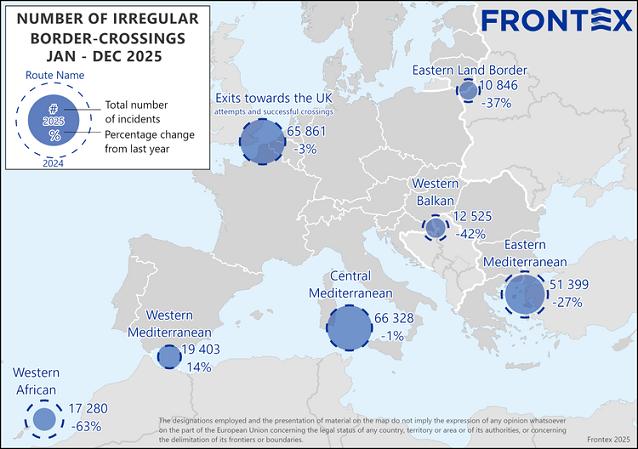
On the Eastern Mediterranean, overall detections fell, but Frontex highlighted a notable shift. Crossings from eastern Libya toward Crete more than tripled, illustrating the agency's warning that migration pressure can quickly re-route when controls tighten elsewhere.
The Western Mediterranean route registered an increase in detections in 2025, driven largely by higher numbers of departures from Algeria, while attempts to cross the English Channel toward the United Kingdom remained broadly in line with 2024 levels.
Nationalities and human cost
According to Frontex's consolidated data tables, the most frequently detected nationalities across all routes in 2025 were Bangladeshis, Egyptians, and Afghans.
Despite the overall decline in crossings, the human toll remained high. Citing estimates from the International Organization for Migration, Frontex said at least 1,878 people died in the Mediterranean in 2025, down from 2,573 the previous year.
Frontex warning
Frontex Executive Director Hans Leijtens cautioned against complacency, saying the downward trend does not remove underlying risks.
"The trend is moving in the right direction, but risks do not disappear," Leijtens said, adding that cooperation has delivered results but that Europe must remain prepared for sudden changes at its borders.
Looking ahead
Frontex said 2026 will be a pivotal year for EU border management, pointing to the planned full application of the EU Pact on Migration and Asylum in June, alongside the rollout of the Entry/Exit System (EES) and the European Travel Information and Authorisation System (ETIAS).
The agency said these measures will reshape how the EU manages external borders, but warned that geopolitical instability and smuggling networks will continue to test Europe's capacity to respond.