
By Bosphorus News Defense Desk
France's nuclear-powered aircraft carrier Charles de Gaulle arrived in the Eastern Mediterranean on March 9, confirmed by President Emmanuel Macron when he boarded the vessel off Cyprus. The carrier had been redirected from NATO exercises in the Baltic and North Atlantic on March 3, covering roughly 7,000 kilometres in under a week.
The full force comprises the Charles de Gaulle, eight frigates, and two Mistral-class amphibious helicopter carriers, representing roughly half of France's major surface combatants. The carrier's air wing includes 20 Rafale fighter jets and three E-2C Hawkeye airborne early warning aircraft. Allied vessels joined the formation: Spain's frigate Cristóbal Colón, the Netherlands' Evertsen, and Italy's Federico Martinengo.
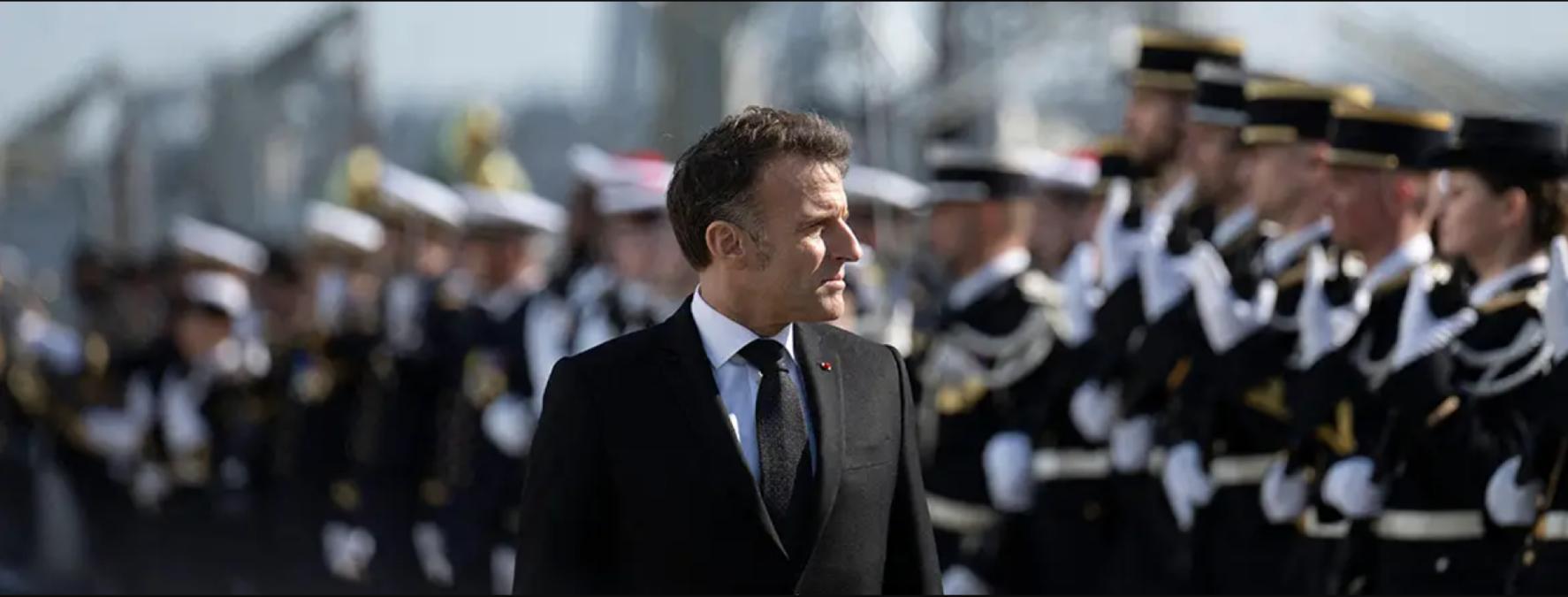
"Few navies are capable of doing what you did, and you did it at a sustained pace, and in an exceptional maneuver," Macron told troops assembled in the carrier's hangar.
What Triggered the Order
The redeployment followed an Iranian drone strike on the British RAF base at Akrotiri in Cyprus on March 1. Macron convened an emergency session of France's Defence and National Security Council and announced the carrier's new orders in a televised address the evening of March 3.
"I have ordered the Charles de Gaulle aircraft carrier, its air assets, and its escort of frigates to set course for the Mediterranean," Macron said. "Today, the Strait of Hormuz is effectively closed. Around 20 percent of the world's oil and liquefied natural gas passes through this strait. The Suez Canal and the Red Sea are also under strain and under threat."
Two French military bases in the region were struck in the opening phase of the Iranian response, causing material damage without casualties. Around 400,000 French citizens are in the Middle East. Macron said repatriation flights were organised for those wishing to leave.
Coalition and Nuclear Signal
France is also working to assemble a multinational coalition to restore and secure commercial shipping through the Strait of Hormuz and the Red Sea. "We have taken the initiative to build a coalition in order to pool the necessary resources, including military ones, so that traffic can be restored and secured in these sea lanes that are essential to the global economy," Macron said.
In the same address, Macron announced that France would expand its nuclear arsenal and cease publishing the exact number of warheads it holds.
Scale No Other European Navy Can Match
With roughly half its major surface combatants now committed to the Eastern Mediterranean, France has mobilised a naval force no other European navy could currently match. Analysts at the European Policy Centre and RUSI described the deployment as unprecedented. Britain is no longer capable of a comparable operation. Germany has shown no willingness to attempt one.
The deployment also prepares France for potential evacuation operations, mirroring its maritime withdrawal during the 2006 Lebanon war. France has more than 400,000 citizens in the Middle East, more than any other European nation.
Greece deployed F-16s and two frigates to Cyprus shortly after the Akrotiri strike. Britain dispatched the Type 45 destroyer HMS Dragon and helicopter assets to the island. The French-built Greek frigate Kimon also joined patrols off Limassol.