
By Bosphorus News Geopolitics Desk
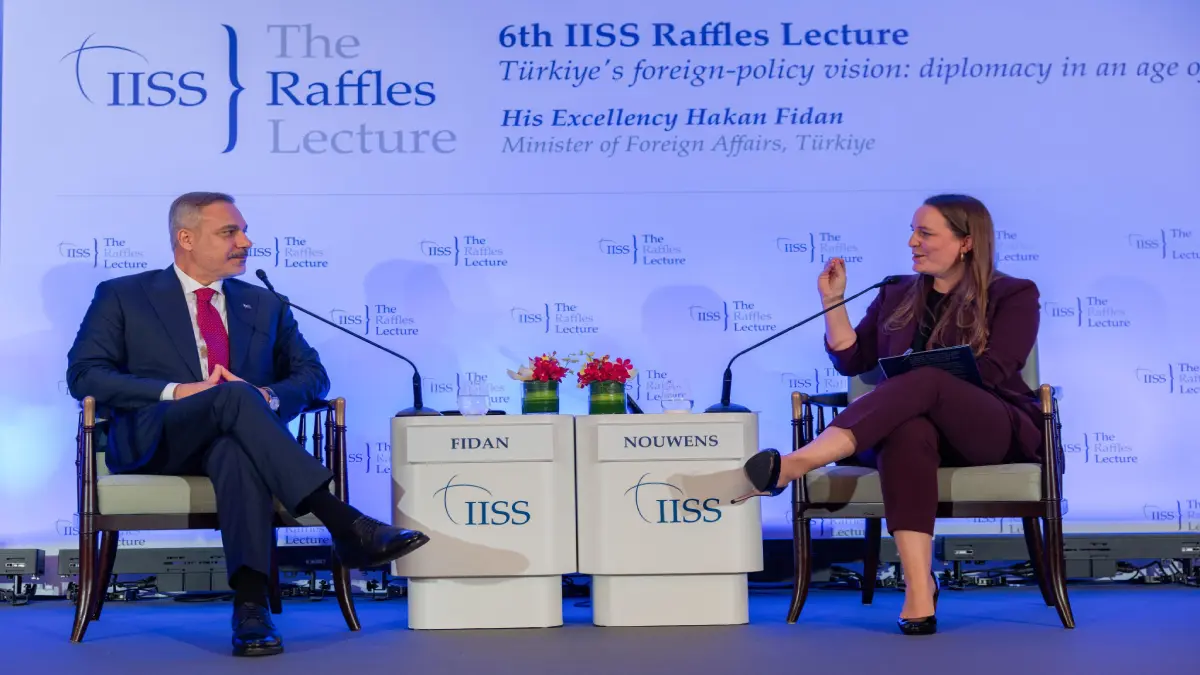
Turkish Foreign Minister Hakan Fidan used the IISS Raffles Lecture in Singapore to frame Türkiye's foreign policy around a post-Hormuz route doctrine, tying active diplomacy, Southeast Asia outreach and alternative connectivity to the disruption of one of the world's most sensitive maritime chokepoints.
The International Institute for Strategic Studies hosted Fidan on 2 June for the sixth IISS Raffles Lecture, titled "Türkiye's foreign-policy vision: diplomacy in an age of uncertainty." The lecture took place during Fidan's official visit to Singapore, where he met Prime Minister Lawrence Wong, Foreign Minister Vivian Balakrishnan and Coordinating Minister for National Security and Minister for Home Affairs K. Shanmugam.
Singapore's Foreign Ministry said the visit was Fidan's first official trip to the country as foreign minister. It placed the talks inside the Türkiye-Singapore Strategic Partnership, launched in 2014, and listed trade, investment, innovation, food security, renewable energy, ASEAN and regional developments among the issues discussed.
Fidan's message moved beyond a bilateral visit. He described an international order where diplomacy, conflict, economics, security, domestic politics and foreign policy increasingly overlap, then placed Türkiye among states that refuse "strategic resignation." In the structure of the speech, that phrase carried a clear foreign policy claim: Ankara does not intend to watch global disorder from the edge of decisions shaped elsewhere.
The route dimension became sharper in the question-and-answer section, where Fidan connected the lessons of the Hormuz disruption with alternative connectivity projects. He referred to work on available prospective routes, including the Syria route and a Türkiye-Saudi Arabia train route, placing transport, security and diplomacy inside the same crisis response.
That language sits inside a pressure map Bosphorus News has already traced, where the Hormuz crisis turned maritime access, Pakistan-Iran diplomacy and Türkiye's corridor role into one energy-security file. Fidan's Singapore remarks carried that file into a broader foreign policy frame, where the issue is not only how energy moves, but which states can keep corridors credible when sea routes are exposed.
This is where the lecture takes on its doctrine character. Fidan was not simply calling for more diplomacy in a difficult world. He was describing diplomacy as a route-making instrument: keeping channels open, widening regional ownership, connecting land corridors to maritime risk and treating transport infrastructure as part of strategic autonomy.
Singapore gave that message a deliberate setting. The city-state sits at the meeting point of trade, ports, finance and Asian security, while Türkiye is trying to connect its own geography to Asia through transport, defense, energy and political channels. Fidan's lecture built on the same Singapore track Bosphorus News recently covered, where his talks placed ASEAN engagement, defense ties and wider Asia diplomacy inside Türkiye's search for a larger role beyond its immediate region.
ASEAN was not decorative in that setting. Fidan presented Southeast Asia as part of Türkiye's Asia Anew Initiative and described ASEAN as an indispensable partner. Singapore's official readout also said Türkiye's intent to deepen cooperation with ASEAN was welcomed, giving the lecture a practical diplomatic base rather than leaving it as a conceptual exercise.
The post-Hormuz element gives that Asian opening a harder edge. A crisis around the Gulf does not only threaten tanker traffic. It forces Ankara to think across the Levant, the Gulf, Central Asia, South Asia and Southeast Asia at once, because every route question eventually becomes a question of political access, infrastructure, customs, ports, security guarantees and partner confidence.
That is why Fidan's references to Syria and a Türkiye-Saudi Arabia rail option deserve attention. Neither should be treated as a completed project. The point is that Ankara is now speaking about the Hormuz shock through a route map rather than a single crisis file. The disruption of one chokepoint becomes an argument for multiplying land and maritime options, even when those options pass through politically difficult geographies.
The Singapore lecture also showed how Türkiye wants to define its role in a period when medium powers are being pushed between passivity and overreach. Fidan's answer was disciplined activism: diplomacy that does not claim to solve every crisis, but keeps Türkiye present in the rooms where routes, ceasefires, energy flows and regional security arrangements are being shaped.
The weakness in any route doctrine is implementation. Syria remains unstable, Gulf connectivity depends on trust and financing, ASEAN engagement needs sustained institutional follow-up, and alternative corridors only matter if they can survive border politics, security shocks and commercial hesitation. Fidan's lecture showed that Ankara understands the shape of the problem. It did not pretend the infrastructure answer has already been built.
Fidan's Singapore message therefore sits at the point where lecture language meets route politics. The Hormuz shock has made clear that Türkiye cannot treat connectivity as a trade file alone, and Ankara's answer is to keep diplomacy close to the corridors it wants to build. Syria, the Gulf, ASEAN and the Singapore track are not separate boxes in that reading. They are parts of the same post-Hormuz map, where the state that can keep routes open, partners engaged and alternatives credible gains weight before the next chokepoint crisis arrives.
***Sources: International Institute for Strategic Studies, Türkiye Ministry of Foreign Affairs, Singapore Ministry of Foreign Affairs, Channel NewsAsia, Bosphorus News reporting.