
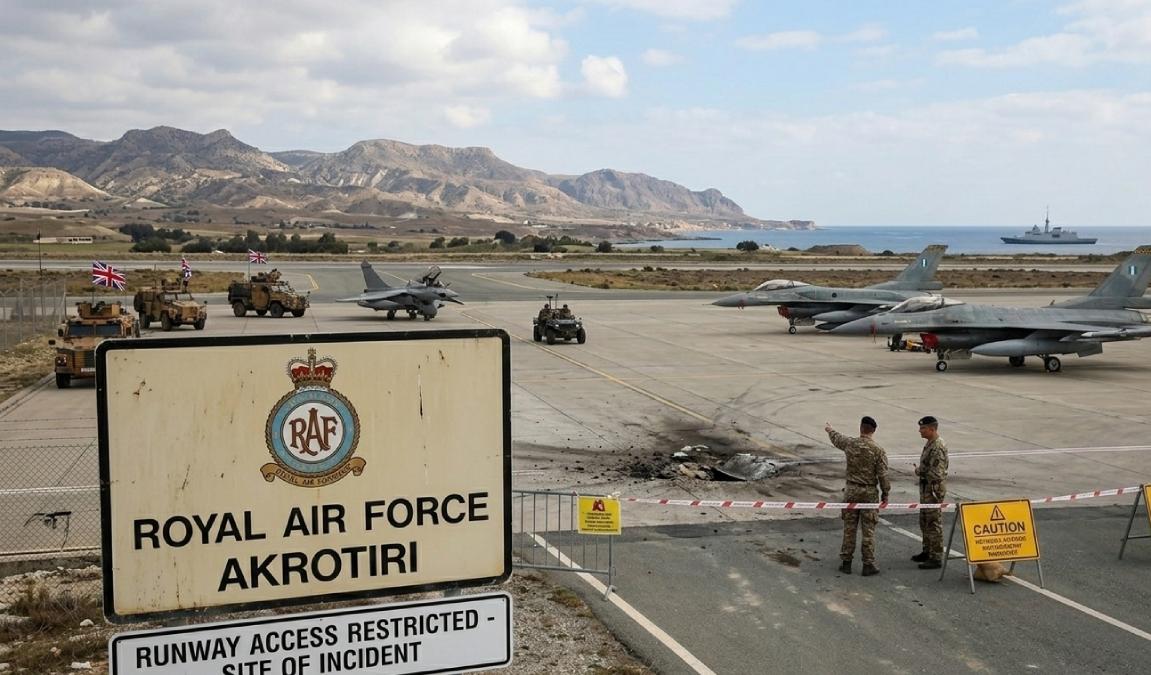
A drone struck the runway of RAF (Royal Air Force) Akrotiri, the British military base on Cyprus, in the early hours of March 2. British officials attributed the attack to an Iranian-made drone launched from Lebanon, most likely by Hezbollah. The strike caused minimal damage and no casualties, but it set off the most significant European military mobilisation in the Eastern Mediterranean in decades.
Greece responded first. Athens dispatched four F-16 fighter jets and two frigates, including the Kimon, the first vessel of Greece's new Belharra-class, to Cyprus. Defence Minister Nikos Dendias flew to Nicosia on March 3, the day after the strike, for talks with President Christodoulides and his Cypriot counterpart Vassilis Palmas. He then visited the Andreas Papandreou Air Base in Paphos where the Greek F-16s had landed. Christodoulides described the Greek response as immediate and said other European states were following its lead.
France moved in parallel. President Emmanuel Macron ordered the Charles de Gaulle carrier strike group, then deployed in northern Europe for exercises, to set course for the Mediterranean. France also sent the frigate Languedoc, equipped with anti-missile and anti-drone systems, directly to Cyprus. Paris authorised a temporary presence of US aircraft at certain French bases, but specified the arrangement did not cover French bases in the Middle East and excluded any offensive operations against Iran.
Britain's Defence Secretary John Healey arrived in Cyprus on March 5 and met his Cypriot counterpart to discuss further reinforcement. Prime Minister Keir Starmer announced that the destroyer HMS (His Majesty's Ship) Dragon and helicopters with counter-drone capabilities were being dispatched to the island. HMS Dragon, a Type 45 air defence destroyer fitted with a Sea Viper missile system, was still being readied in Portsmouth as of March 5 and is not expected to arrive until next week. Starmer was explicit that British bases on Cyprus were not being used and would not be used by the United States for offensive operations against Iran.
Spain announced it would send its most advanced warship, the Cristóbal Colón frigate, to the Eastern Mediterranean. The frigate had been training with the Charles de Gaulle in the Baltic Sea and is expected to reach waters off Crete around March 10. Italy's Defence Minister Guido Crosetto told parliament on March 5 that Italy would join France, Spain and the Netherlands in sending naval assets to Cyprus in the coming days. Prime Minister Giorgia Meloni was unambiguous: Italy is not at war and does not intend to become party to the conflict. The Netherlands is also contributing, with the frigate Evertsen heading toward the Mediterranean, though Dutch defence officials had not yet determined its precise tasking as of March 5.
Germany's position is one of political support without confirmed military deployment. Chancellor Friedrich Merz said Berlin would assist in preventative measures, and Christodoulides confirmed he had spoken directly with Merz. German defence officials indicated they saw no urgency in contributing naval assets to a Cyprus protection mission, saying current allied regional defence arrangements were sufficient.
The collective European posture is defensive in framing and defensive in practice. Italy, Spain and the Netherlands each ruled out any offensive role. Every country has drawn the same line.
Beyond Cyprus, the conflict has put Red Sea shipping under acute pressure. The EU (European Union) Aspides naval mission is being reinforced to protect commercial traffic from Houthi attacks. Major container carriers including Maersk and CMA CGM have rerouted vessels away from the Middle East, opting for the longer Cape of Good Hope route rather than the Suez Canal.