

The Central Bank Illusion: Debt Management is the New Mandate
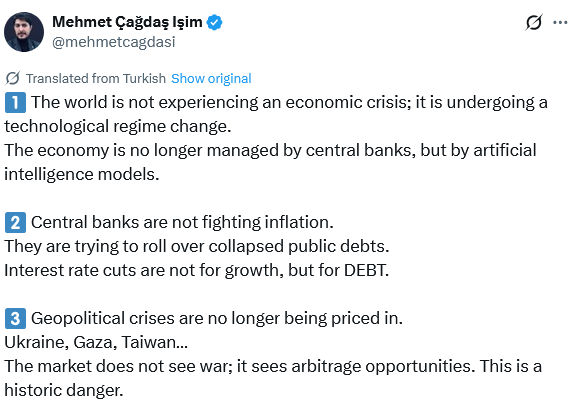
Işim fundamentally challenges the popular narrative surrounding monetary policy. He contends that global central banks are no longer primarily focused on controlling inflation or managing the overall economy.
Instead, their main role has quietly shifted to a political one: managing and rolling over collapsing public debts. According to Işim, interest rate cuts, often presented as tools to stimulate growth, are increasingly measures taken to prevent governments from becoming insolvent due to crippling debt loads.
AI, Data, and Energy: The New Pillars of Global Power
Işim asserts that the decisive factors in the new economic order are technological, not traditional market dynamics.
- Algorithmic States: He describes large technology corporations as having morphed into "algorithmic states," where the ownership of data and AI models determines global power dynamics.
- The 'Green' Geopolitical Operation: The shift toward green energy is not simply an environmental movement, but a large-scale geopolitical operation designed to fundamentally reshape global energy dependencies. Energy and data are the twin engines of this new regime.
- Permanent Inflation: Inflation in many nations is becoming structural and permanent. It is being determined by technological transition costs, new supply chain fragilities, and market monopolization, rather than traditional consumer demand cycles.
Shifting Financial Order and Turkey's Challenge
Işim acknowledges that while the US Dollar's dominance persists, trust in the existing financial architecture is eroding. This distrust is fueling increased gold purchases, the growth of non-SWIFT trade systems, and energy-backed agreements—all signs of a search for a viable alternative financial order.
For developing nations, Işim suggests a critical split is occurring:
- Those that can successfully create technology and energy policies.
- Those that remain trapped in a self-perpetuating cycle of debt and populism.
He concludes that Turkey currently falls into the second category, with its economic problems being deeper issues of governance and trust that manifest as economic symptoms, leading to the systemic fracture and decline of the middle class.