
Bosphorus News Geopolitics Desk
A February 2, 2026 report published by the Jewish Institute for National Security of America calls for the emerging defense cooperation among Greece, the Greek Cypriot administration, and Israel to be formalized into a standing Eastern Mediterranean security architecture with stronger institutional backing from the United States.
Founded in 1976 and based in Washington, D.C., JINSA is a U.S. defense policy institute focused on American national security strategy and the U.S.–Israel security relationship. Its work is directed primarily at policymakers, members of Congress, and military officials.
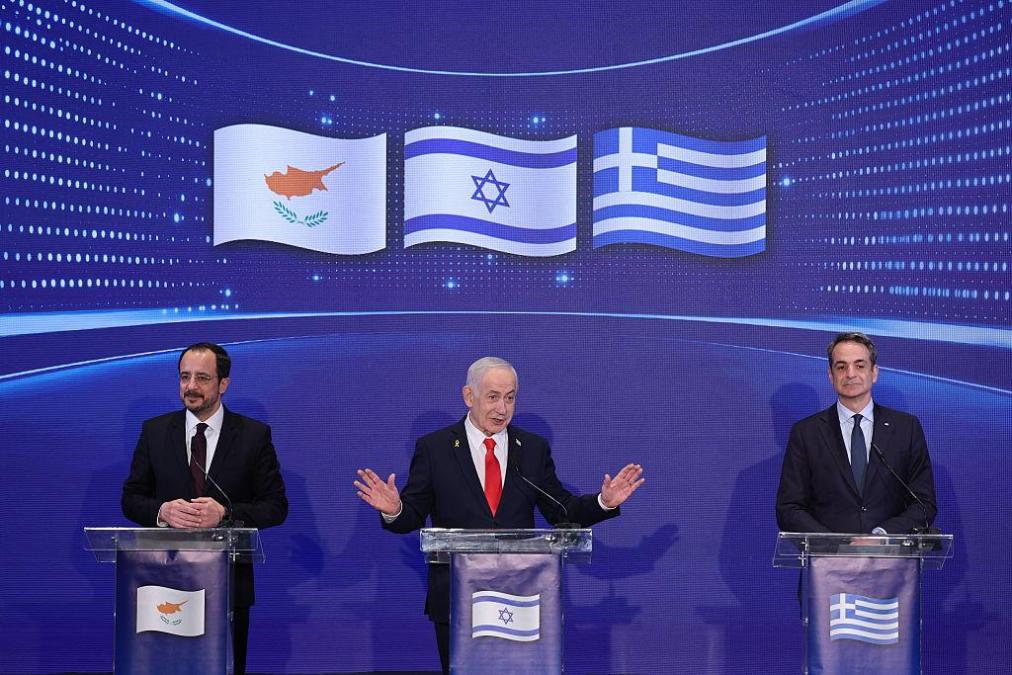
Titled "Beyond the Water's Edge: The Eastern Mediterranean's Strengthening Security Axis," the report states that the post–October 7 security environment has shifted the trilateral framework from energy coordination toward operational military integration. It cites Cyprus's acquisition of Israel's Barak MX air defense system, Greece's purchase of LORA missile systems, and Athens's planned multi-layered "Achilles Shield" air defense project as indicators of this transition. The December 2025 trilateral summit in Jerusalem is presented as a turning point from energy-centered coordination toward structured defense cooperation.
Türkiye in the Report's Framework
The report identifies Türkiye as a central variable in the evolving regional security structure. It refers to Ankara's maritime posture in the Eastern Mediterranean through references to "expansive maritime claims" and the "Blue Homeland" doctrine, and describes Greek-Israeli-Cypriot coordination in part as a hedge against Turkish policy.
It raises concerns regarding Türkiye's military posture in Syria and the potential implications for Israeli operational freedom, ongoing airspace tensions between Türkiye and Greece, Ankara's continued military presence in northern Cyprus, and what it describes as Türkiye's political and financial ties to Hamas.
Syria is characterized in the report as the primary arena where Turkish and Israeli security interests could intersect in ways that increase the risk of miscalculation.
F-35 Conditionality
In its policy section, the report recommends that any potential Turkish return to the F-35 program be subject to defined conditions. These include ending political and financial support to Hamas, normalizing diplomatic and economic relations with Israel, halting airspace violations involving Greece, ceasing pressure on Greek Cypriot energy activities, and reducing military pressure in northern Cyprus.
The report also states that the 2024 approval of F-16 sales to Türkiye did not produce a moderation in Ankara's regional posture.
U.S. Institutional Role
Beyond the Türkiye dimension, the report urges Washington to transform the existing 3+1 format into a permanent security structure, appoint a dedicated Eastern Mediterranean coordinator, and expand defense interoperability and co-production among the three partners. It argues that such a structure could link U.S. European and Gulf partners within a broader aligned security framework.
The Eastern Mediterranean is described as a contested strategic theater, and the proposed architecture is situated within the statutory framework of the 2019 Eastern Mediterranean Security and Energy Partnership Act.