
By Bosphorus News Geopolitics Desk
A March 2026 academic study published in the Journal of Sustainable Development in Social and Environmental Sciences by Dimyana Safwat Botrous classifies the actors of the Eastern Mediterranean through three overlapping categories: states locked in resource disputes, countries able to cooperate through existing gas agreements, and regional or international powers using the basin's energy competition to advance wider strategic agendas. The paper places Türkiye prominently in the third category, while also treating maritime law, gas discoveries and alliance-building as connected parts of the same geopolitical struggle.
That framework is useful because the Eastern Mediterranean can no longer be read only through offshore fields, drilling licenses or pipeline proposals. The region has become a dense legal and political arena in which each maritime claim carries consequences beyond the energy sector. Gas discoveries have created new commercial incentives, but they have also sharpened old disputes over sovereignty, islands, continental shelves, Exclusive Economic Zones and military access.
The study's most valuable contribution is its attempt to separate the region into patterns rather than treating every dispute as an isolated crisis. Türkiye and Greece remain divided by competing readings of the Aegean, where the continental shelf, territorial waters and airspace disputes still define the strategic atmosphere. Türkiye and the Greek Cypriot administration remain locked in a hydrocarbon dispute rooted in the unresolved Cyprus issue. Israel and Lebanon moved from indirect confrontation to a US-mediated maritime deal in 2022, while the Palestinian offshore question remains tied to the wider conflict over Gaza and control of maritime access.
The cooperation track is equally important. Egypt and Cyprus signed a maritime delimitation agreement in 2003, Israel and Cyprus followed with their own agreement in 2010, and Egypt and Greece moved in 2020 with a deal widely understood as a response to Türkiye's maritime memorandum with Libya. The Eastern Mediterranean Gas Forum, launched in Cairo in 2019 with Egypt, Israel, Greece, Cyprus, Italy, Jordan and the Palestinian Authority, gave that alignment an institutional structure. The paper itself notes that Türkiye's absence creates a problem for the forum's legitimacy, given its NATO role, military weight, economic scale and energy needs.
This is where the politics becomes sharper. Cooperation in the Eastern Mediterranean has not grown as an inclusive regional order. It has developed through selective alignments that bring some actors inside the room and leave others outside it. Türkiye's exclusion from the Eastern Mediterranean Gas Forum cannot be separated from Ankara's harder maritime posture, the expansion of the Mavi Vatan doctrine and its insistence that no durable energy architecture can be built by bypassing the longest mainland coastline in the basin.
Türkiye's position rests on a legal and strategic objection that the paper explains but does not always treat with sufficient balance. Ankara has not signed or ratified the United Nations Convention on the Law of the Sea, largely because it rejects interpretations that grant islands maritime zones capable of cutting off mainland coastlines from resource-rich waters. The study records Türkiye's concern that certain UNCLOS provisions could restrict its maritime claims and limit access to oil and gas zones, particularly in disputes involving Greece and Cyprus.
That legal objection is backed by presence at sea. Türkiye has used naval deployments, research vessels and drilling-related activity to challenge what it sees as unilateral Greek Cypriot control over offshore resources. In the Cyprus theatre, Ankara argues that the Greek Cypriot administration cannot exploit hydrocarbon reserves without Turkish Cypriot participation. The study acknowledges that Türkiye and Turkish Cypriots rejected unilateral Greek Cypriot energy activity, while also noting that the United States and European Union repeatedly affirmed the Republic of Cyprus's sovereign rights in its Exclusive Economic Zone.
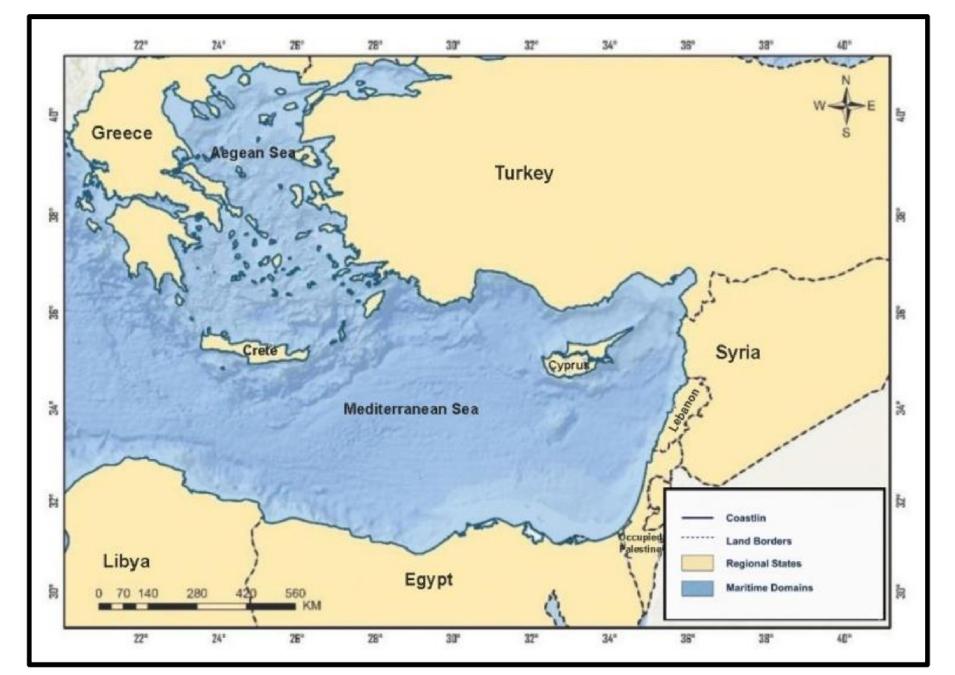
The 2019 Türkiye-Libya maritime memorandum is the third pillar of Ankara's posture. It was a counter-map designed to break a regional geometry shaped by Greece, Cyprus, Egypt and Israel. Greece, Cyprus and Egypt rejected the agreement, but Ankara's message was clear: Türkiye would not accept a Mediterranean map drawn through island-based claims that reduce its access from the south. The agreement also connected maritime law with military and political leverage in Libya, where Türkiye backed the Government of National Accord and tied its energy posture to a broader regional security role.
The study is strongest when it shows how gas cooperation and geopolitical rivalry now operate together. It is weaker when its language absorbs the legal framing of Türkiye's rivals. Phrases presenting Turkish actions as "unlawful," or describing the Libya memorandum mainly through the lens of domination over disputed waters, require caution. The same applies to the study's broad suggestion that Türkiye has lost sympathy in Europe and that Turkish-EU relations are almost certain to deteriorate. Those judgments may reflect a real diplomatic environment, but they move beyond neutral classification and into interpretive language shaped heavily by the Greek and Greek Cypriot legal view.
External actors make the picture more complicated. The United States has deepened cooperation with Greece, Israel and Cyprus, while viewing Eastern Mediterranean gas as part of Europe's diversification away from Russian energy. The study says Washington's posture implicitly refers to Türkiye as an actor obstructing exploration around Cyprus, and later places Türkiye alongside Russia, China and Iran within a wider field of influence to be countered. That framing is especially sensitive because Türkiye remains a NATO member and a central military actor in the same regional security architecture the US is trying to shape.
France, Russia, China and Gulf states also appear in the wider balance. France supports the emerging Greece-Cyprus-Israel alignment and has opposed Turkish moves in the basin. Russia keeps influence through Syria and energy positions. China's role is less military but increasingly visible through port and infrastructure investment. Gulf involvement is more geoeconomic than ideological, but it adds another layer to the region's investment politics.
The export problem remains the hardest practical constraint. EastMed, the Arab Gas Pipeline, the Israel-Egypt route and the Egypt-Cyprus connection all face a mixture of cost, deep-water engineering, political mistrust and security risk. The presence of gas does not automatically create a viable export system. Every route carries a political price, and every pipeline proposal forces the same question: who is included in the map, who is excluded from it, and who has enough power to make the route work?
The Eastern Mediterranean is therefore better understood as a struggle over political geography than as a conventional energy race. Gas fields matter, but they matter because they turn maritime claims into strategic positions. Türkiye's role sits at the centre of that struggle. It is treated by rival blocs as a disruptive actor, yet its geography, navy, energy demand, Libya connection and Turkish Cypriot commitments make it impossible to design a stable regional order without confronting its claims.
That is the real value of the Botrous study. It maps the actors, the blocs and the pressure points. Its own language also shows the deeper problem: even academic classification in the Eastern Mediterranean cannot escape the legal and political battle over how the region should be described.
Full Study: Botrous, Dimyana Safwat. The Geopolitical Classification of Actors in the Eastern Mediterranean Basin. Journal of Sustainable Development in Social and Environmental Sciences, Vol. 5, Issue 1, March 2026. https://journals.ekb.eg/article_490819_6ae2a2ccf68deae060b5b65457849ed0.pdf