
By Bosphorus News Geopolitics Desk
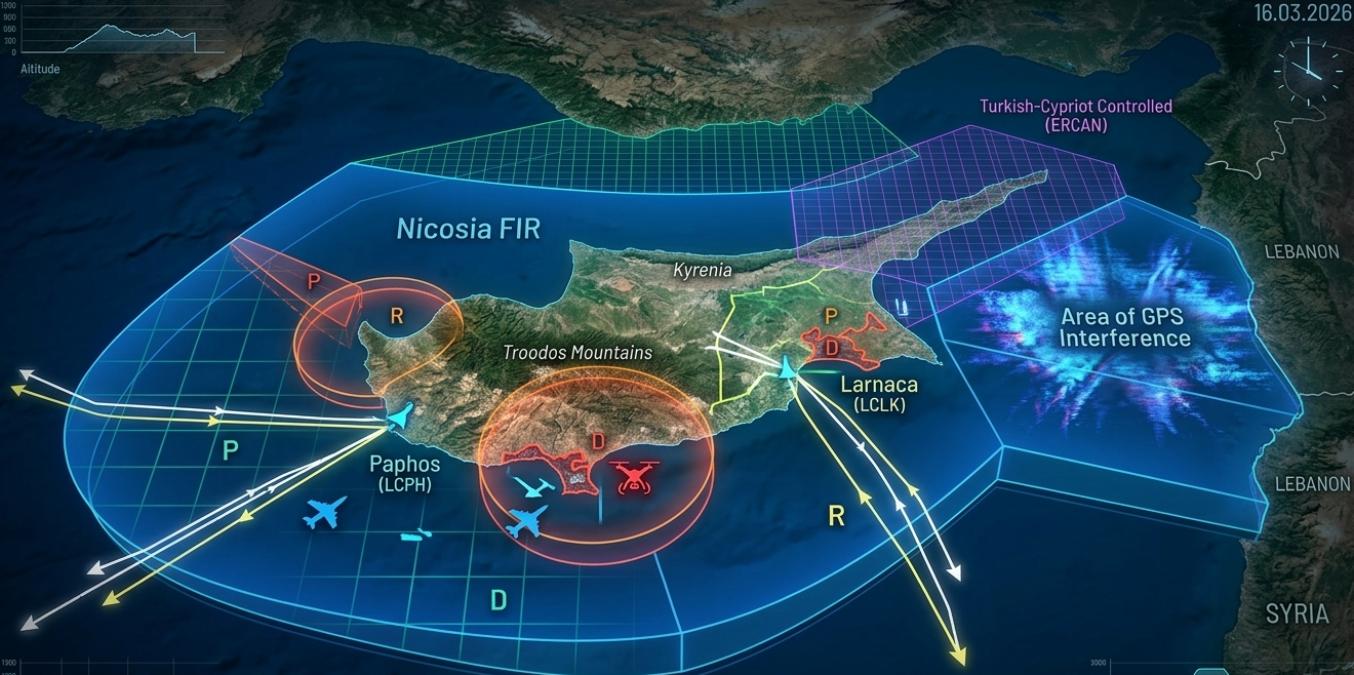
On March 16, Ercan airport published NOTAM NO100/26, declaring that NOTAM A0345/26, issued by Nicosia through the Kyrenia Interactive Map System, carries no legal weight within Ercan Advisory Airspace. The TRNC Ministry of Public Works and Transport backed the notice with a written statement, asserting that the TRNC is the sole authority for air traffic and aeronautical information services in that airspace, and urging all aircraft in the region to coordinate exclusively with TRNC air traffic units.
Nicosia's NOTAM A0345/26 warned of possible military operations in airspace covering southern and eastern waters off Cyprus, from surface level to approximately 18,000 feet, instructing pilots to remain in continuous radio contact with Cypriot ATC.
How the Sequence Unfolded
The dispute began with NOTAM A0332/26, which Nicosia issued on March 13. That notice explicitly named possible US military operations over a wide area stretching across northern Cyprus and the coastlines between Mersin, Adana, and Hatay. Nicosia later replaced it with A0345/26, stripping out the US reference and substituting the phrase "possible military operations." The replacement retained coverage over territory that overlaps with Ercan Advisory Airspace, which is what drew the TRNC response.
Serdar Denktaş, son of TRNC founding president Rauf Denktaş and a former foreign minister and deputy prime minister of Northern Cyprus, had called for exactly this kind of action on March 1, two weeks before the government acted. "The Ercan Civil Aviation Authority must immediately issue a NOTAM and announce that our airspace cannot be used," he said. Denktaş leads the TAM Party.
Forces on the Ground
The NOTAM dispute is inseparable from the military buildup that preceded it. On March 9, Türkiye deployed six F-16C fighters and Hisar-A surface-to-air missile systems to Ercan, citing the need to protect the Turkish Cypriot population. Greece had already sent four F-16s to Paphos. The USS George HW Bush carrier group is operating in the wider Eastern Mediterranean, and a new NOTAM issued today warns of possible military operations off the Karpas peninsula in the island's northeast, an area where the original A0332/26 had explicitly flagged US activity before the reference was removed.
NATO air and missile assets in the region have downed three Iranian ballistic missiles since the conflict began. Intelligence and diplomatic sources in both Türkiye and Cyprus confirmed to the Cyprus Mail that the first interception, on March 4, involved a missile aimed at the Incirlik airbase in Adana.
The Strike That Changed Everything
The immediate trigger for the region's rapid militarisation was the March 1 drone strike on RAF Akrotiri. A Shahed-type loitering munition hit the base's runway shortly after midnight, causing limited damage and no casualties. Cypriot officials assessed it as an Iranian-made system fired from Lebanon. Two further drones were intercepted the same day; on March 4, Greek F-16s intercepted two more in Lebanese airspace before they reached Cyprus.
The UK deployed Martlet-armed Wildcat helicopters and the air-defence destroyer HMS Dragon in response. France, Greece, Italy, the Netherlands, and Spain all moved assets to or near the island in the days that followed.
Open Airport, Closed Corridors
Cyprus's airports have remained technically open throughout. The government has held that line consistently: "At the moment, Cyprus' airspace is operating normally," spokesman Konstantinos Letymbiotis said on March 2.
The flight data tells a different story. Between March 1 and 10, Larnaca recorded more than 320 cancellations; Paphos logged over 80. On March 11 alone, 36 flights were scrubbed, mostly services to Tel Aviv, Haifa, Doha, and Beirut. East-bound routes via Lebanon, Israel, and the Gulf have become commercially unworkable for most carriers, a product of closed airspace beyond Cyprus's borders and the sharp rise in war-risk insurance premiums on conflict-adjacent routes. European services have largely continued.