
By Murat Yıldız
When Cyprus government spokesman Konstantinos Letymbiotis was asked on March 2 whether Nicosia would seek to renegotiate the legal basis of the UK's Sovereign Base Areas (SBAs), he offered no reassurance. "In this context, we are not ruling anything out," he said. The remark came a day after an Iranian drone struck RAF Akrotiri, the British base in Cyprus, within 800 yards of British personnel, on soil that Cyprus has no formal authority over, in a conflict Cyprus had no formal role in joining. It was the first time a Cypriot official had declined to defend the permanence of an arrangement that has governed the island's relationship with Britain since independence.
The 1960 treaty committed Britain to using the bases for military purposes. It said nothing about whose military purposes they would serve, or what risks they might create for the island and people hosting them. For sixty-five years that ambiguity held without serious challenge. On March 1, 2026, a drone brought it into the open.
The 1960 Settlement
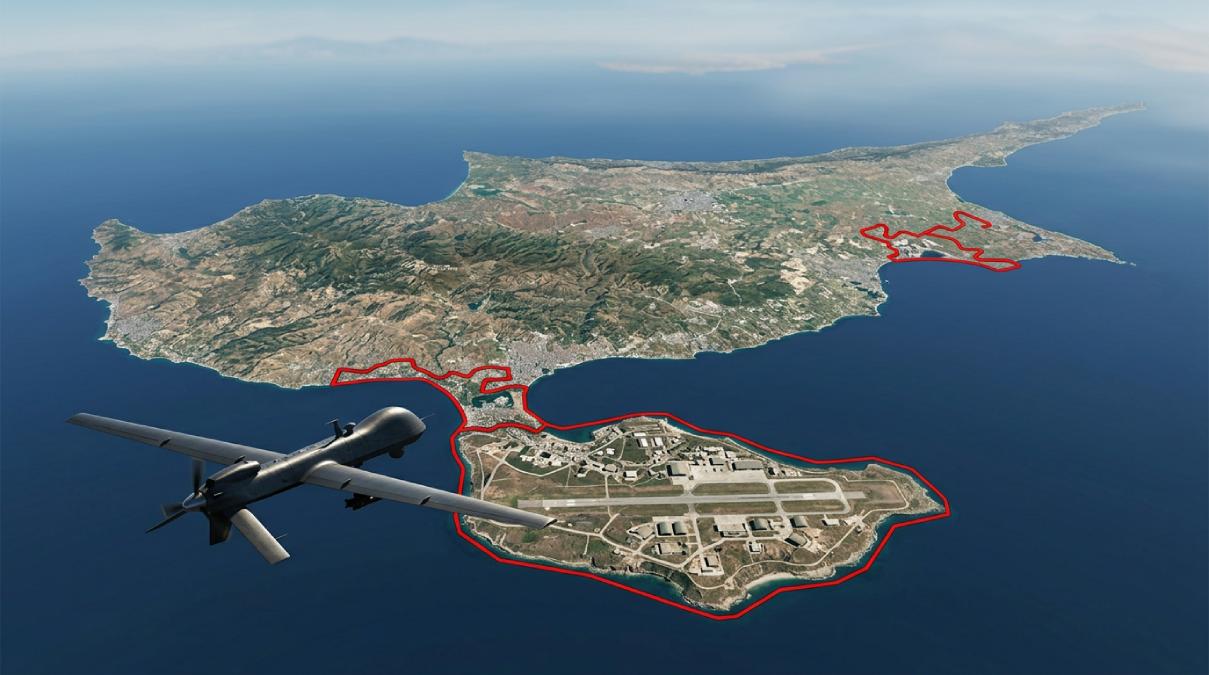
The Treaty Concerning the Establishment of the Republic of Cyprus, signed on August 16, 1960, was a condition of independence rather than a lease agreement. Britain retained full sovereignty over two areas of the island, Akrotiri in the southwest and Dhekelia in the east, covering 98 square miles, roughly 3% of the island's territory. The accompanying Treaty of Guarantee assigned three external powers, the UK, Greece, and Türkiye, as guarantors of Cyprus's independence, territorial integrity, and security.
The UK committed in a declaration attached to the treaty to use the SBAs exclusively for military purposes, not to establish civilian infrastructure, and to protect the rights of Cypriots living within the base areas. Around 10,000 Cypriots currently reside inside the SBAs. The treaty made no provision for a future in which the bases would become a forward mounting platform for operations that Cyprus neither endorsed nor received advance warning about.
Two Years of Friction Before the Drone
The March 1 strike did not arrive without context. Since October 2023, the SBAs had become a recurring source of friction between London and Nicosia. Claims emerged that the bases were hosting US forces and providing logistical support to Israeli operations in Gaza. The UK denied providing military equipment to Israel but later confirmed, in October 2025, that it had conducted unarmed surveillance flights over Gaza from December 2023, focused solely on locating hostages, with the last flight on October 10, 2025. The bases were also used for UK air strikes against Houthi targets in Yemen in January and February 2024, prompting protests outside RAF Akrotiri. Each time, operations were conducted or authorised and Cyprus was informed, if at all, after the fact. The UK's consistent position was that there is no formal requirement to consult Cyprus before conducting operations from the SBAs, with ministers describing engagement with Nicosia as routine rather than obligatory. For three years Cyprus had watched its territory serve as a platform for regional operations in which it had no voice, accumulating a frustration that had found no formal outlet, until a drone made the question of the bases' purpose impossible to defer any further.
The Base Itself Becomes the Target
On February 28, US and Israeli strikes on Iran began. On March 1, before any warning reached Cypriot citizens living near Akrotiri, an Iranian drone struck the base within 800 yards of British personnel. Hours later, Starmer announced that the UK had granted the US permission to use British bases for the limited purpose of destroying Iranian missile sources. The following day, two more drones heading for the base were intercepted by Cypriot authorities, and only in his March 2 Commons statement did Starmer clarify that the Cyprus SBAs were not suitable for the US operations in question and would not be used. Nicosia had by then absorbed the political cost of an announcement it had not been warned about, received the security assurance only after the public had already processed the risk, and been told in retrospect that it had nothing to worry about.
Cypriot officials believed the drones were fired by Hezbollah from Lebanon, though the UK Ministry of Defence did not confirm this assessment. Letymbiotis's response addressed that sequence directly. His refusal to rule out renegotiation was a statement about process and trust, not only about treaty text.
Türkiye: Guarantor, Critic, Interested Party
Any attempt to renegotiate the bases runs directly into Türkiye's treaty position. Under the 1960 Treaty of Guarantee, Türkiye is one of three guarantor powers, obligated alongside Greece and the UK to respect the integrity of the SBAs and to guarantee the UK's rights within them, making any revision of the SBA framework a matter that requires Türkiye's formal engagement rather than a bilateral negotiation between Nicosia and London.
Ankara's relationship with the bases carries its own contradictions. The Turkish Republic of Northern Cyprus (TRNC), recognised only by Türkiye, has criticised the use of the SBAs to support Israeli operations. Türkiye itself suspended trade with Israel after October 7 and has consistently backed the Palestinian cause, placing itself in direct opposition to the purposes for which the bases have been most visibly used since 2023. As a guarantor power it is legally obligated to protect the UK's base rights. As a state that has positioned itself against Western military operations in the region, it carries political incentives that point in a different direction.
This is the paradox Nicosia may try to exploit. Türkiye is legally bound to protect arrangements that have been used to conduct operations it has publicly and consistently opposed. A Cypriot renegotiation bid would place Türkiye in the position of either defending base rights it finds politically indefensible, or standing aside from its guarantor obligations in a way that would set a precedent with implications well beyond Cyprus, and Nicosia's negotiators would be aware of the difficulty that creates for Ankara.
The geography adds another layer that goes beyond treaty obligations. The Dhekelia SBA interrupts the United Nations buffer zone, known as the Green Line, in the east of the island, and controls two of the crossing points between the Republic of Cyprus and the TRNC, crossings that serve as among the primary physical connections between the two sides of a divided island and whose administration sits entirely within British sovereign territory. Any revision of Dhekelia's status would directly affect the movement of people and goods across a boundary that Türkiye has maintained and defended since its 1974 military intervention. Renegotiating the SBA framework is therefore not an abstract treaty question for Türkiye but a challenge that touches the practical mechanics of a division Turkish policy has maintained since 1974.
The Distance Between a Statement and a Treaty
Nicosia has not formally initiated anything. Letymbiotis declined to rule out renegotiation; he did not announce it. The more immediate and achievable prospect is a Memorandum of Understanding (MoU) establishing a formal notification and consultation requirement before the UK authorises third-party use of the bases. Such an instrument would leave the 1960 treaty intact, would not require the consent of the guarantor powers, and could in principle be negotiated bilaterally between Nicosia and London within months. It would represent the first formal acknowledgement that Cyprus has a legitimate interest in how its hosted bases are used, without touching the sovereignty question that makes a fuller revision so complicated.
A treaty amendment, which would require the agreement of all three guarantor powers, formal diplomatic engagement across multiple capitals, and a negotiating process measured in years rather than months, is a different order of undertaking entirely. Greece is closely aligned with Nicosia and unlikely to obstruct. Türkiye's position is, as argued above, genuinely ambiguous. The UK would be negotiating constraints on its own sovereign territory, with every institutional incentive to resist meaningful limitation. Nicosia's negotiators would know that an MoU is winnable; a treaty amendment is a generational commitment with no guaranteed outcome.
There is a further complication specific to Türkiye. Ankara does not recognise the Republic of Cyprus as a sovereign state, a position it has maintained since 1963. Any formal treaty negotiation would require Türkiye to sit at a table with a government whose legal existence it refuses to acknowledge, a procedural contradiction that Nicosia's negotiators would need to navigate and that Ankara could use to delay or obstruct the process indefinitely.
The exclusion extends beyond Nicosia. Turkish Cypriots living on the island have no seat at any table where the bases' future might be discussed, despite bearing the same physical risks as anyone else on the island. The TRNC is recognised by no state other than Türkiye, which means Turkish Cypriot interests can only enter the negotiation indirectly, filtered through Ankara's own calculations, a government whose strategic priorities do not necessarily align with the security concerns of the people living closest to the bases.
A 1960 Commitment That Has Outgrown Its Terms
Cyprus joined the European Union in 2004, forty-four years after the base agreement was written. The SBAs occupy a peculiar position within that framework: two patches of British sovereign territory embedded inside an EU member state, governed by a colonial-era treaty that predates not only Cyprus's EU membership but the existence of the European Union itself. EU law does not apply within the SBAs, a carve-out negotiated through Protocol 3 of the 2003 Cyprus Accession Treaty, which integrated the bases into the EU customs territory to avoid a hard border while leaving their security governance entirely outside EU jurisdiction, a gap that the 2004 accession erased on the economic side but left entirely intact on the security side.
Around 10,000 Cypriot citizens, all of them EU citizens, live within the SBAs under the executive authority of a British military commander, with no EU-level institution and no democratic mechanism through which they can influence decisions about the operations conducted from the territory they inhabit. The March 1 drone strike made that abstraction concrete: EU citizens were placed at risk by a sequence of decisions taken in London, without the knowledge or consent of the government of the EU member state on whose island those decisions landed.
Nicosia's grievance is that the definition of military purposes has expanded, without notice or limit, to encompass operations that generate direct threats to the island on which the bases sit. Letymbiotis's statement on March 2 was the first public signal that Nicosia no longer sees this gap as sustainable, and whether it produces formal negotiations, a revised consultation protocol, or nothing at all will depend on decisions not yet taken in any of the capitals that would need to be party to them.
***This analysis draws on UK House of Commons Library Research Briefing No. 10540, "The UK Sovereign Base Areas in Cyprus: Status and recent developments," published March 3, 2026, by Stefano Fella. Treaty references are drawn from UN Treaty No. 5475 (Treaty of Guarantee) and Treaty No. 5476 (Treaty of Nicosia), both signed August 16, 1960. UK Government statements are sourced from Hansard and official government press releases cited within the briefing. The analysis of Türkiye's non-recognition of the Republic of Cyprus and the absence of Turkish Cypriot representation in any prospective negotiation reflects the authors' own analytical conclusions, drawing on the established legal and political record.