
By Bosphorus News Geopolitics Desk
A drone struck a hangar at the Royal Air Force base at Akrotiri on 1 March 2026. Cyprus's foreign minister Constantinos Kombos identified it as an Iranian-manufactured Shahed type, launched from Lebanon. Damage was limited, but the response that followed was not.
In the weeks since, seven European countries have moved naval and air assets to Cyprus or its immediate waters. Türkiye has reinforced its position in the north. The island is being fortified from both sides by actors with different legal mandates and different reasons for being there.
The Buildup Predates the Strike
The military concentration around Cyprus did not begin on 1 March. Expansion works at Mari naval base, Cyprus's only dedicated naval facility on the south coast, were already underway. The estimated cost runs to around €200 million. The US Navy's Naval Mobile Construction Battalion had been assisting with earthworks since 2023, building a heliport under a bilateral defence cooperation agreement. Harbour expansion, linked to a separate military cooperation agreement with France, is expected to complete around 2027, allowing the base to accommodate foreign warships.
Andreas Papandreou Air Base in Paphos was being upgraded in parallel, at an estimated cost of around €14 million. Cyprus's defence minister has confirmed that partner countries will be able to use both facilities once works are complete, subject to Cypriot government approval. The discussions that produced these plans were held directly with Washington during President Christodoulides's visit to the White House in October 2024. The infrastructure being built at Mari and Paphos was in the ground before Iran flew a single drone toward the island.
Akrotiri After the Strike
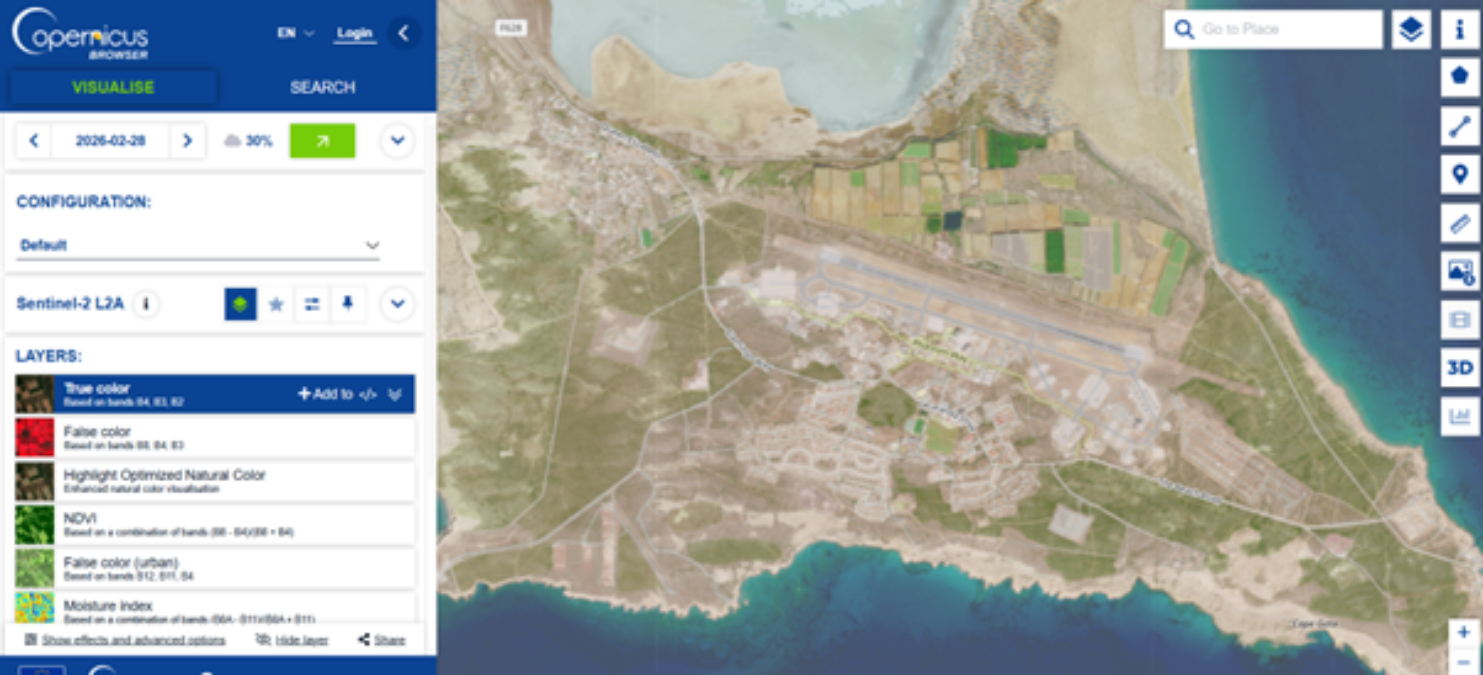
By 6 February, the United Kingdom had pre-positioned six F-35B Lightning II jets at Akrotiri, where ten Eurofighter Typhoons were already stationed. The base can handle F-35Bs, Typhoons, Voyager aerial-refuelling aircraft, and Atlas transport planes. Together with Dhekelia, it covers roughly 98 square miles of Cypriot territory under British sovereignty, retained since the 1960 independence treaty, housing around 3,800 British military personnel and civilians.
After 1 March, Britain added HMS Dragon, a Type 45 air-defence destroyer, along with Wildcat helicopters armed with Martlet counter-drone missiles. Service families were evacuated. British Defence Secretary John Healey flew to the island in person. A base that was already the busiest air operations hub in the region shifted from a forward posture to an active one.
Greece's Response
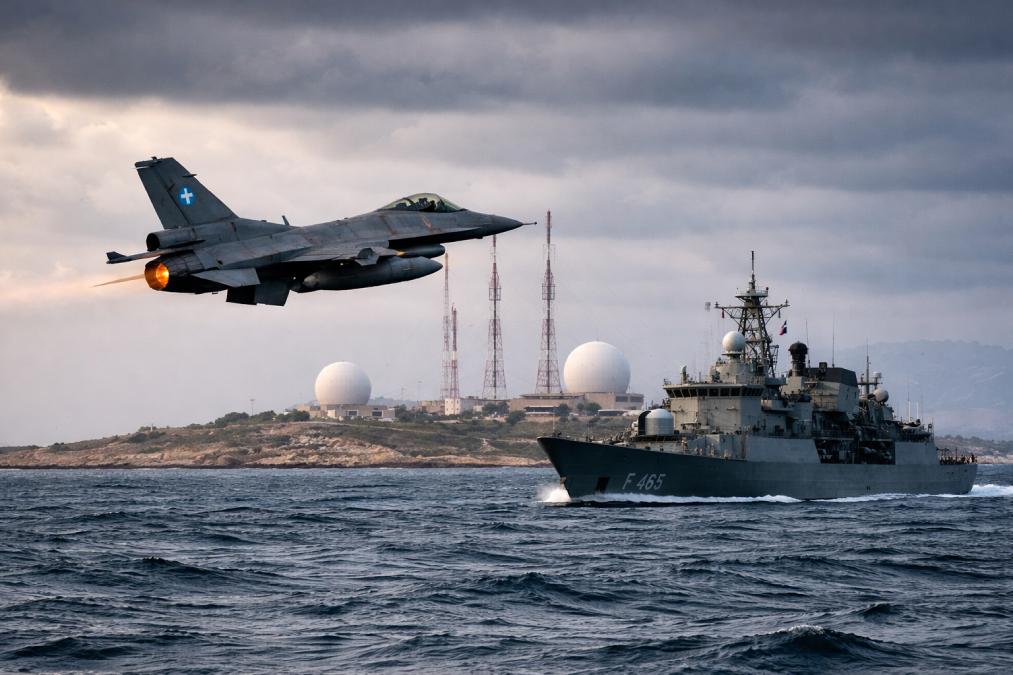
Greece dispatched two frigates within 24 hours of the strike. The first, Kimon, was the Hellenic Navy's newest ship, commissioned in December 2025: its first operational deployment was to Cyprus. Equipped with a SEAFIRE radar covering 300 kilometres and ASTER 30 Block 1 surface-to-air missiles, it provided immediate air-defence cover. The second frigate, Psara, carries an electronic-warfare suite for detecting and disrupting low-altitude drones. Four F-16 Viper jets were deployed to Andreas Papandreou Air Base in Paphos. On 4 March, two of those jets intercepted drones headed for the island in Lebanese airspace, according to Cypriot government statements.
Greece simultaneously positioned a Patriot battery on Karpathos, closing the defensive gap between the Greek mainland and Cyprus and creating an arc of air cover extending toward the Levant.
European Reinforcements
France redirected the nuclear-powered aircraft carrier Charles de Gaulle from the Baltic Sea to the eastern Mediterranean, with its full air wing and escort frigates. The French frigate Languedoc reached Cypriot waters the same evening as President Macron's announcement. Rafale jets, airborne radar aircraft, and additional air-defence systems followed. Spain, Italy, the Netherlands, and Germany all added frigates and air-defence assets, turning the waters around Cyprus into one of the most heavily patrolled stretches of sea in the Mediterranean. Macron described the scale of French naval mobilisation as "unprecedented."
On a map, Cyprus now resembles a fixed aircraft carrier whose decks, hangars, and radar masts belong to different states.
Türkiye's Northern Buildup
On 9 March, Türkiye deployed six F-16C fighter aircraft to Ercan airport in northern Cyprus. AKP spokesman Ömer Çelik described the move as a measure to reinforce regional balance and protect Turkish Cypriots, and said it was not directed at any specific country.
Geçitkale airbase, formally transferred to the Turkish Armed Forces in January 2024, has hosted drone operations since 2019, including surveillance and strike missions over the eastern Mediterranean. Bayraktar Akıncı and TB2 unmanned combat aircraft are stationed there alongside Hisar-A surface-to-air missiles.
Further north, a network of radar and maritime surveillance stations is being built at Karpasia, Livera, and Ayios Theodoros, with a central command facility under construction in Famagusta. The network forms the nervous system of what Ankara calls its Steel Dome, a layered air and maritime surveillance concept designed to provide continuous monitoring of movement around the island.
Airspace
NOTAM A0126/26, issued under the Nicosia Flight Information Region, warns of GPS spoofing and jamming across Cypriot airspace through 1 May 2026, advising crews to use conventional navigation. EASA has separately identified the eastern Mediterranean, covering the area around Cyprus, Türkiye, Lebanon, Syria, and Israel, as a region where GNSS interference has intensified significantly since 2022. Available open-source data does not allow attribution to a single actor. Crews flying through the corridor are navigating with less reliable positioning data regardless of who is responsible.
Cypriot Position
The crisis has pushed Cyprus into a role it did not seek. Following the 1 March strike, Nicosia condemned London for failing to publicly clarify the scope of Akrotiri's use and did not rule out renegotiating the bases' terms. Civil society protests outside the Presidential Palace called for an end to military cooperation with Greece, Israel, and the United States, with demonstrators describing the British bases as a source of exposure rather than protection.
Government policy has been moving in a different direction. In December 2025, Cyprus, Greece, and Israel signed a trilateral defence cooperation plan covering joint exercises and procurement. The Mari and Paphos upgrade discussions were held directly with Washington before the current crisis began.
Türkiye holds guarantor power status over Cyprus under the 1960 treaty. Its buildup in the north is framed as a symmetrical response to what Ankara describes as destabilising militarisation in the south. The forces now present on both ends of the island answer to different capitals, operate under different legal arrangements, and have given no indication of what happens when the immediate pressure lifts.
***Source note: Deployment figures draw on official statements from the UK, French, Greek, Cypriot, and Turkish defence ministries. The 4 March drone interception is sourced from Cypriot government statements and corroborated by multiple media reports. Base infrastructure data is sourced from Cyprus Mail, Naval News, and Cypriot parliamentary records. NOTAM A0126/26 is from the Nicosia FIR official record. Electronic warfare attribution remains unconfirmed in open-source reporting and is presented accordingly.