
By Bosphorus Geopolitics Desk
The Clearest Signal Comes from Cyprus
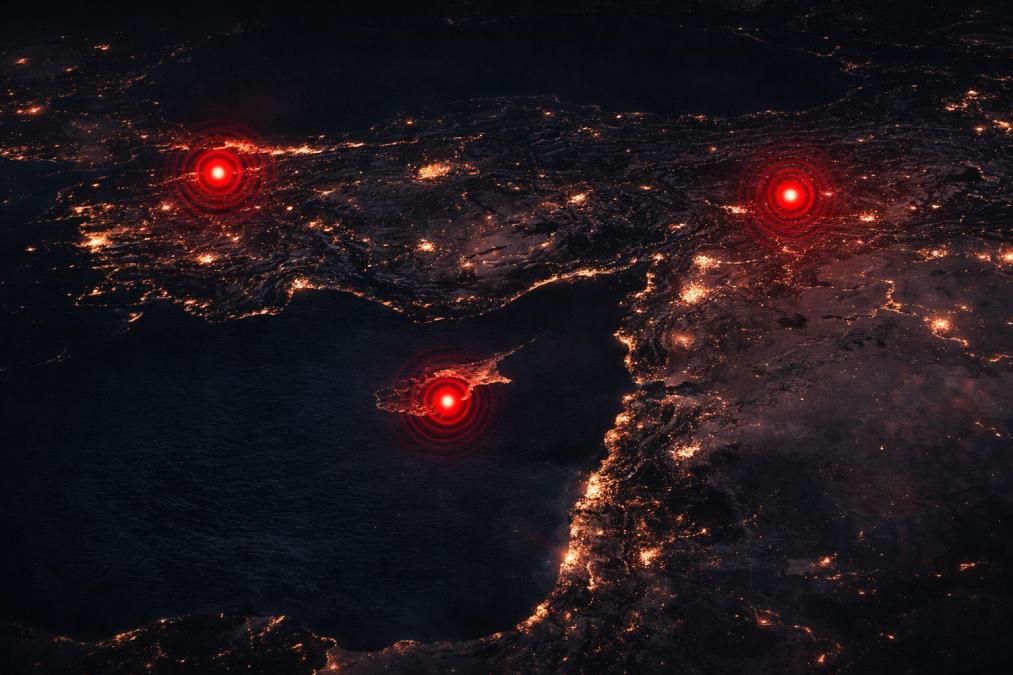
The most concrete evidence of a regional security shift emerged not from a government press conference, but from a local Cypriot report. A March 10 account from In-Cyprus and Philenews, drawing on security sources, indicated that two Iran-linked suspects had been under surveillance before the March 1 drone strike on RAF Akrotiri. Cypriot security services were already at elevated readiness before the attack, not because of it.
The strike itself, in which a Shahed-type drone hit the Akrotiri runway shortly after midnight on March 2, was the first direct attack on a British military installation on the island since 1986. It brought the Iran war physically onto EU territory and set off a series of official security reassessments across the region.
The UK's Foreign, Commonwealth and Development Office updated its Cyprus travel advice to state that "terrorist attacks in Cyprus cannot be ruled out," adding that "attacks could be indiscriminate, including in places visited by foreign nationals."
The update, published on March 5, stopped short of advising against travel but marked a formal shift in the UK's threat assessment for the island.
The United States Department of State elevated its Cyprus travel advisory to Level 3: Reconsider Travel, citing armed conflict risk and limited US government assistance capacity on the island.
Both governments moved within days of each other, without any public coordination announcement, which points to a shared intelligence picture rather than a routine policy update.
Greece: 50 Targets, Red Alert at Airports
Sources from the Greek Police told the news website newsit.gr that for the first time in recent years, the risk of a terrorist attack inside Greece had become visible. Major airports were placed on red alert, with passengers arriving from specific countries and carrying a suspicious profile being systematically screened. A 24-hour coordination network with allied intelligence services was activated, and domestic extremist cells were placed under increased surveillance.
Security measures were extended to cover approximately 50 potential targets across Greece, including diplomatic missions and locations associated with Israeli and American interests.
Days later, the threat picture sharpened further. On March 11, a previously unknown group calling itself the Islamic Movement of the Companions of the Right claimed an attack at a Jewish site in Greece, after claiming responsibility for a synagogue bombing in Liège, Belgium. The group's name and logo resemble those of Iraqi armed groups and Hezbollah, both closely aligned with Iran.
The Long War Journal, which first reported the group's activity, was unable to independently verify the Greek claim, and no open-source confirmation has emerged. It is included here as a contextual signal, not confirmed fact.
The World Jewish Congress raised alarm over the group's broader European activity, stating that "security analysts believe the group may be part of Iran's expanding network of proxy actors operating far beyond the Middle East."
Türkiye: Elevated Conditions, Added Pressure
Türkiye entered the current period already under active counter-terrorism warnings. The US State Department's standing advisory notes that terrorist groups continue to plot possible attacks in the country, with particular focus on crowded spaces, transport hubs, and locations associated with Western interests.
The Atlantic Council assessed that Türkiye is deeply concerned about IRGC-linked networks and the potential for Kurdish mobilization on its borders, navigating the Iran war with significant security as well as economic anxiety.
President Erdoğan, addressing the nation after NATO intercepted an Iranian ballistic missile headed toward Turkish airspace on March 4, said Ankara was "leaving absolutely nothing to chance regarding the security of our borders and airspace" and was taking all necessary precautions in consultation with NATO allies.
His remarks focused on airspace and military defence. But Iran's mosaic defence strategy, which decentralises operational authority to local IRGC commanders, makes the line between external military threat and internal security risk harder to hold.
What the Major Outlets Are Missing
Reuters, the BBC, and other major outlets have covered the military dimensions of the Eastern Mediterranean crisis in detail: F-16 deployments, frigate movements, NOTAM disputes. The counter-terrorism layer has received far less attention.
In Cyprus, security services were tracking Iran-linked suspects before the Akrotiri strike. In Greece, police hardened protection around 50 potential targets and activated allied intelligence coordination. In Türkiye, counter-terrorism readiness has intensified under the combined weight of standing threat warnings and the direct pressure of Iranian missiles in its airspace.
None of the three governments has publicly announced a formal terror alert escalation. The tightening has been real regardless.
***This report draws on the UK Foreign, Commonwealth and Development Office, the US Department of State, Keep Talking Greece, In-Cyprus, Philenews, FDD's Long War Journal, the Atlantic Council, Al Jazeera, and the Middle East Institute. The claimed attack in Greece attributed to IMCR has not been independently verified. It is referenced as a contextual signal only.