
By Bosphorus News Geopolitics Desk
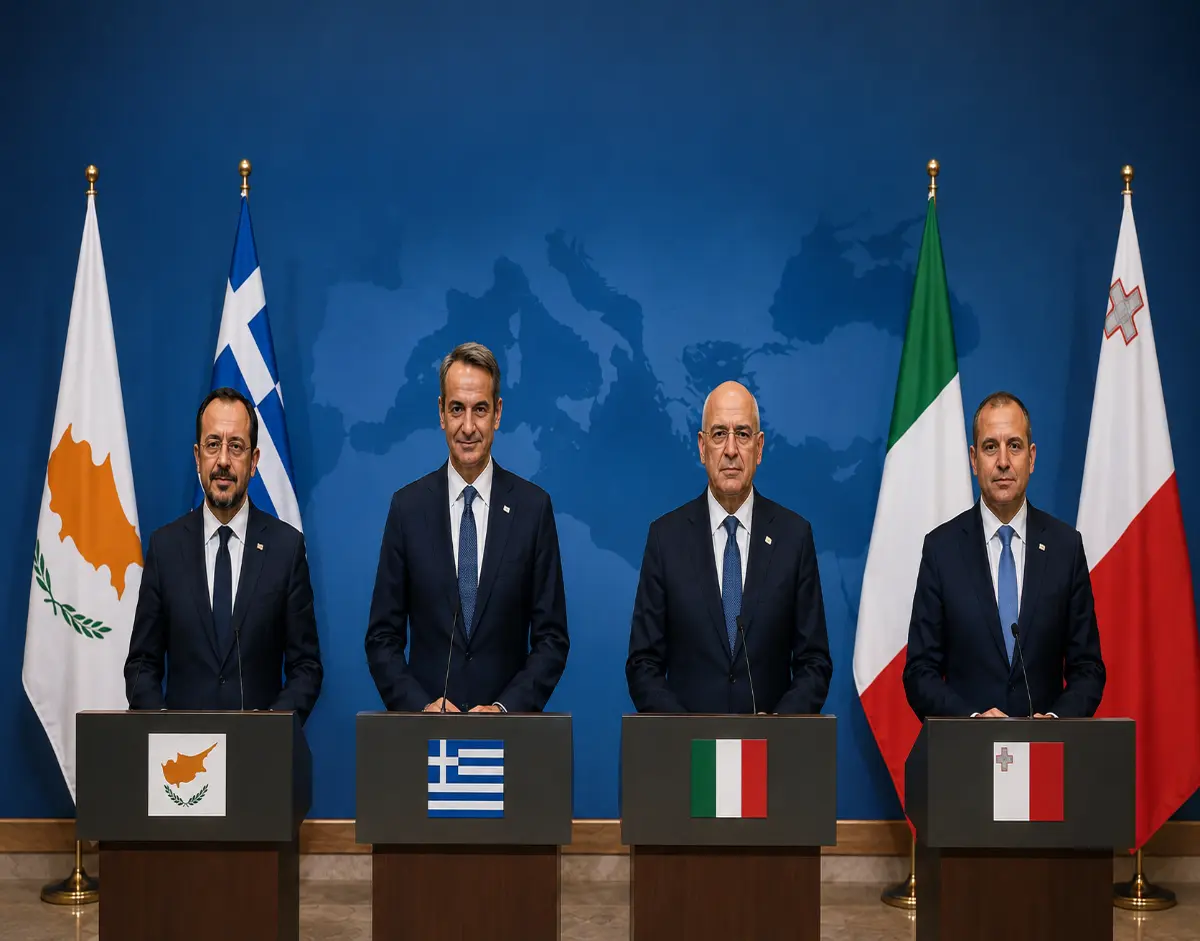
Cyprus, Greece, Italy and Malta have agreed to coordinate more closely on migration risks linked to the security situation in the Middle East, warning that Europe must prevent a repeat of the 2015 migration crisis.
The leaders issued a joint statement on the occasion of the Europe Gulf Forum, following up on their previous meeting in Agia Napa, Cyprus. The statement said the four Mediterranean EU states most exposed to uncontrolled and irregular migration flows toward Europe would continue work across security, humanitarian assistance, EU asylum rules and joint border preparedness.
The four leaders said any response should include support for efforts to improve security in the region, assistance for affected populations and full implementation of the EU's new Pact on Migration and Asylum.
They also pointed to the updated EU legal framework for crisis situations, including the instrumentalisation of migration, force majeure and hybrid threats. Regulation 2024/1359 addresses exceptional migration and asylum crises, including instrumentalisation and force majeure, and provides temporary measures, enhanced solidarity and support tools inside the European Union.
The statement marks a clear attempt by Cyprus, Greece, Italy and Malta to move early before any new population movement from the Middle East reaches EU borders. The four states sit along the Mediterranean's most exposed migration routes and have repeatedly pushed Brussels for stronger burden sharing, faster returns, tighter external border control and deeper cooperation with countries of origin and transit.
The leaders said the concrete options under review include stronger cooperation with countries of origin and transit, intensified action against human traffickers and migrant smugglers and the possible activation of the EU Regulation on crisis situations and force majeure.
That formulation is important because it links the Middle East security file directly to the EU's new migration machinery. The statement does not declare a migration emergency. It says the countries are preparing for the possibility of a significant increase in flows and want the legal and operational tools ready before pressure builds.
The Italian Interior Minister, Matteo Piantedosi, will invite his counterparts from Cyprus, Greece and Malta to meet in Rome on June 17, 2026. The meeting is expected to focus on maximising national responses to possible migration flows linked to the Middle East conflict.
The four leaders also welcomed the Chisinau Declaration on Migration, adopted by consensus on May 15 at the 135th Session of the Council of Europe's Committee of Ministers. The European Commission said the declaration recognises significant and complex migration challenges facing member states and links migration management with the European Convention on Human Rights framework.
Cyprus has become more central to the Mediterranean migration debate as the island faces pressure from the Levant, particularly from Lebanon and Syria. Greece remains focused on the Aegean and eastern Mediterranean routes, while Italy and Malta continue to push for a stronger EU response across the central Mediterranean. The joint format gives the four states a smaller, more operational platform inside the wider EU debate.
The language of the statement also reflects a harder European migration vocabulary. It combines humanitarian support and respect for international law with border control, smuggling networks, crisis regulations and hybrid threats. That mix shows how migration linked to the Middle East is now being treated not only as a humanitarian issue, but also as a border security and resilience problem for southern EU states.
The next test will come in Rome. If the June 17 meeting produces a concrete package, Cyprus, Greece, Italy and Malta could push Brussels toward earlier use of crisis tools under the new Pact on Migration and Asylum. If it remains at the level of coordination, the statement will still mark a political warning from the EU's southern flank: the Mediterranean states do not want to wait for a new 2015-style crisis before activating the legal and operational machinery now available to them.
***Sources: Joint statement by the leaders of Cyprus, Greece, Italy and Malta; European Commission; European Union Regulation 2024/1359.