
By Bosphorus News Geopolitics Desk
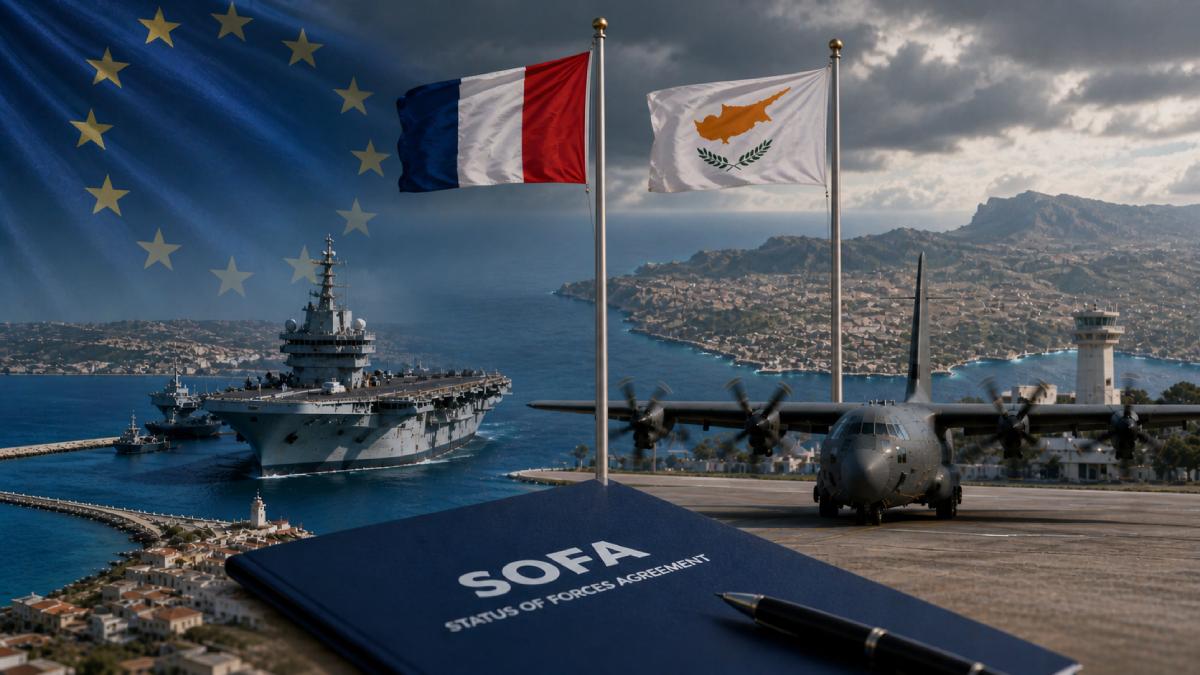
Cyprus and France are moving toward a Status of Forces Agreement expected in June, with regional reporting placing the signing around the 7-8 June informal European Union defense ministers' meeting in Lefkosia.
The meeting will take place at the Filoxenia Conference Centre, where European Union defense ministers are due to discuss defense readiness and new security challenges. The expected Cyprus-France signing gives the gathering a sharper Eastern Mediterranean weight, because it would move an already close bilateral defense partnership into a more operational phase on an island where Türkiye remains a guarantor power under the 1960 security framework.
Greek Cypriot President Nikos Christodoulides said on 26 April that the agreement would be signed at ministerial level in June and would regulate the presence of French forces in Cyprus for humanitarian purposes. Government spokesman Konstantinos Letymbiotis presented the file as part of a relationship with France that has reached its highest level, while Greek Cypriot defense sources cited in local reporting linked the timing to the 7-8 June European Union defense ministers' meeting.
The agreement is expected to define the presence, movement and activities of French personnel in Cyprus, including jurisdiction, taxation, customs procedures and deployment conditions. Nicosia frames the Status of Forces Agreement as a humanitarian and operational tool. Ankara and the Turkish Cypriot side read it through a different lens: the island's military balance, Türkiye's guarantor role and the exclusion of the Turkish Cypriots from decisions made by the Greek Cypriot administration.
The planned agreement would move the Cyprus-France relationship from strategic language into operational rules, building on a trend Bosphorus News previously examined in Cyprus's effort to position itself as an EU security hub with French backing and Turkish pushback.
The file also sits inside the Article 42.7 debate, the European Union's mutual defense clause. Christodoulides pushed during April's European Union discussions for a more operational blueprint on how the clause would work in practice. French President Emmanuel Macron reinforced that line in Athens, saying Article 42.7 could not remain only words. In Lefkosia, Macron went further by saying that when Cyprus is attacked, all of Europe is attacked.
Paris later tried to contain the political reading of that message. French spokesman Christophe Confavreux said in early May that Türkiye was not being targeted and that France remained committed to developing relations with Ankara. The clarification did not remove Ankara's central concern that a European defense architecture is being built around Cyprus while Türkiye, a NATO member and a guarantor power on the island, remains outside the institutional frame.
That exclusion runs through several files at once, rather than through the Status of Forces Agreement alone. Türkiye has sought access to the European Union's Permanent Structured Cooperation Military Mobility project, but Greece and Cyprus have blocked its participation. Cyprus is now pushing Article 42.7 implementation while also deepening its bilateral defense relationship with France. From Ankara's perspective, the issue is wider than one French-Cypriot document, because it concerns a European security channel in the Eastern Mediterranean where Cyprus and Greece can shape the rules while Türkiye is kept outside.
The same pattern is also visible in procurement and defense industry planning. Cyprus has been linked to talks for French Griffon armored vehicles and Serval light tactical vehicles, with defense reporting pointing to the European Union's Security Action for Europe instrument as a possible financing route. Security Action for Europe is the European Union's loan mechanism for large-scale joint defense procurement, which gives the Cyprus-France file a financial and industrial layer beyond the legal status of French forces.
Türkiye's Ministry of National Defense has warned that French military activity in southern Cyprus could disturb the existing balance and increase tensions in the region. The ministry also said such steps could create security risks for the Greek Cypriot administration itself. Defense Minister Yaşar Güler has separately warned that European defense initiatives excluding Türkiye would damage European security rather than strengthen it.
The Turkish Cypriot response has been sharper. The Turkish Republic of Northern Cyprus Foreign Ministry said the agreement would be "null and void" for the Turkish Cypriot people, arguing that the Greek Cypriot administration has no authority to represent the island as a whole. The ministry said the agreement would enable the deployment of French military elements, deepen defense industry cooperation, expand joint exercises, increase military training and support logistical arrangements.
Turkish Republic of Northern Cyprus Prime Minister Ünal Üstel accused Macron and the European Union of maintaining a colonial mindset, while Parliament Speaker Ziya Öztürkler said the balance on the island is not determined by French soldiers but by the presence of Türkiye. The language shows that the dispute has already moved beyond legal procedure and has become part of the contest over who defines security in and around Cyprus.
The timing sharpens the problem. Türkiye is conducting Denizkurdu-II/2026 across the Black Sea, the Marmara Sea, the Aegean and the Eastern Mediterranean, a naval exercise Bosphorus News detailed as a four-sea military signal. Ankara is also weighing the timing of a Blue Homeland maritime jurisdiction bill that has not yet been submitted to parliament, while the NATO leaders' summit scheduled in Ankara in July will place southern flank security back on the alliance calendar.
Those tracks now overlap. Cyprus and France are turning a strategic partnership into rules for forces on the ground. The European Union is trying to make its mutual defense clause more operational. Cyprus is moving closer to French defense industry channels. Türkiye is warning that the island's balance is being altered without Ankara or the Turkish Cypriot side. The argument is no longer only about whether French personnel can operate in Cyprus. It is about whether the island's security order is being rewritten through European defense tools while one of its guarantor powers is kept outside the room.
***Sources: Cyprus Presidency of the Council of the European Union, Council of the European Union, Cyprus News Agency, Cyprus Mail, France Diplomatie, French presidency remarks, Türkiye Ministry of National Defense, Turkish Republic of Northern Cyprus Foreign Ministry, Anadolu Agency, Army Recognition, European Commission and Bosphorus News reporting.