
Bosphorus News Energy Desk
Cyprus and Israel have moved forward on regulatory coordination for a direct electricity interconnection, pushing a narrower and potentially faster track at a moment when the broader Eastern Mediterranean subsea cable agenda remains delayed by unresolved questions over governance, financing, and regional politics.
Regulatory authorities in Nicosia and Jerusalem have entered a more operational phase, exchanging cost–benefit data and working through pricing logic and tariff structures for a Cyprus–Israel link. The talks have shifted from general alignment to the core issues that determine whether a project can be commissioned: who pays, how costs are recovered, and how end users are charged.
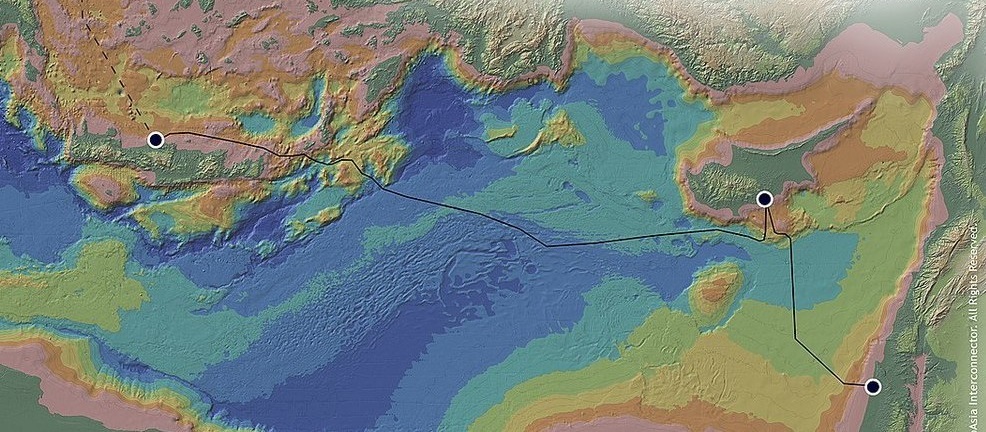
This bilateral movement stands in contrast to the Great Sea Interconnector, the planned high-voltage subsea cable designed to connect Cyprus with Crete and mainland Greece and, in a wider architecture, integrate Israel into the European electricity system. Despite strategic framing and European support, the flagship route has struggled to convert intent into execution. Cost allocation disputes, unclear ownership of investment risk, and institutional frictions between stakeholders have repeatedly surfaced as the binding constraint.
The financing logic also diverges. While the Greece–Cyprus segment has been promoted as a European priority project with access to EU instruments, the Cyprus–Israel link is expected to rely primarily on user-based financing unless alternative funding is secured. That difference matters. It narrows the political perimeter, disciplines the regulatory conversation, and may allow progress on a segment that can be priced and justified without requiring full alignment on the broader route.
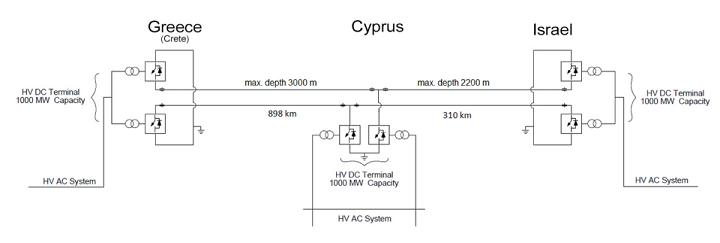
The Great Sea Interconnector's strategic case is straightforward on paper: end Cyprus' long-standing energy isolation, create a new corridor for electricity trade, and hardwire the Eastern Mediterranean into Europe's energy map. But the project's trajectory underscores a recurring regional lesson: when infrastructure begins to encode political choices, engineering stops being the hard part. Timelines slip not because cables cannot be laid, but because authority is fragmented and accountability is diffuse.
From Türkiye's perspective, this is not a technical story. It is a political one. Connectivity schemes that proceed as if maritime jurisdiction, regional representation, and the Cyprus question were administratively settled tend to attract friction at the implementation stage. The Cyprus–Israel regulatory track may still produce practical, limited progress. Whether it can be scaled into a wider grid without confronting the questions it currently sidesteps remains uncertain. In that sense, uncertainty is not merely the byproduct of delay. It is the operating condition of Eastern Mediterranean energy connectivity.
Whether it can be scaled into a wider grid, if there is or will be any political space left for consensus, remains unresolved.