
By Bosphorus News Geopolitcs Desk
The plan, as reported
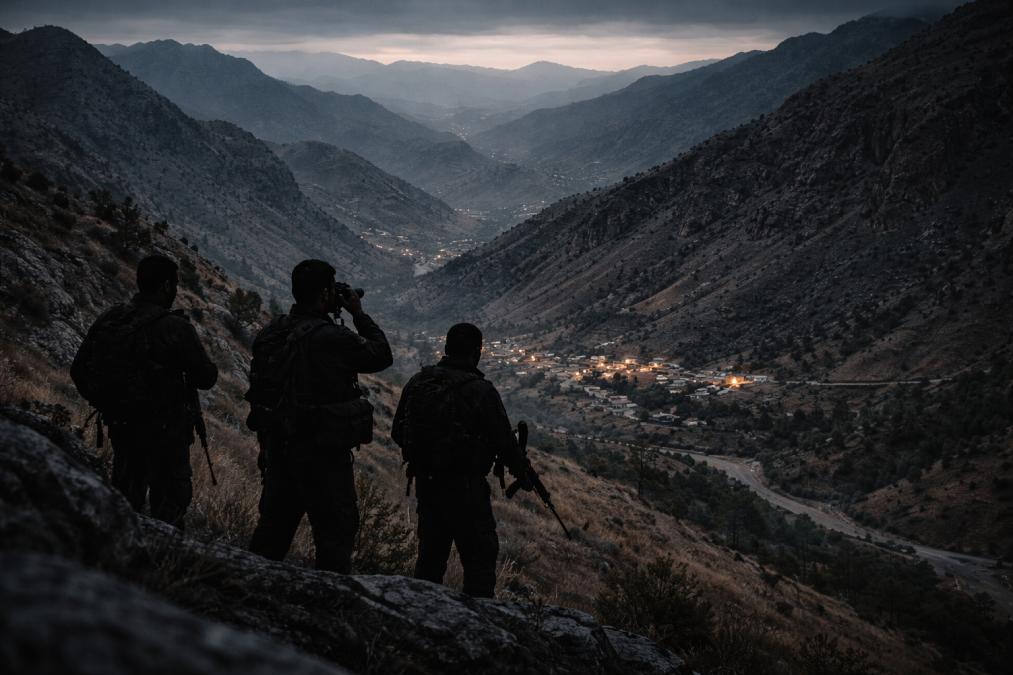
Iranian Kurdish militias consulted with the United States in early March about whether and how to attack Iran's security forces in the country's northwest, three sources with knowledge of the matter told Reuters. Two said no final decision had been made.
CNN reported separately, citing multiple people familiar with the plan, that the CIA was working to arm Kurdish forces to create conditions for a popular uprising. The stated logic: Kurdish armed groups would engage Iranian security forces in the west, pinning them down and opening space for unarmed protests in major cities. A secondary goal, per US and Israeli officials cited by Axios, was for Kurdish forces to seize and hold territory in northern Iran, creating a buffer for Israel.
Reuters said it could not independently confirm the CIA's role, whether weapons had been transferred, or whether US personnel planned to accompany any groups into Iran.
The plan's origin, according to Axios, was Israeli. Netanyahu and the Mossad pushed the idea for months before the war began. The CIA joined the effort later. Israel has long-established intelligence networks among Kurdish groups in Iran, Iraq, and Syria, and Israeli officials reportedly promised Kurdish factions not only military support but political backing for a Kurdish autonomous region in a post-regime Iran.
Any operation would require Iraqi Kurdish cooperation: weapons would need to transit through the Kurdistan Region of Iraq, and the terrain of Iraqi Kurdistan would serve as the launching ground. Both Masoud Barzani and Bafel Talabani, whom Trump called the day after the bombing campaign began, expressed reservations about getting involved, according to Axios.
Fractured groups, unconfirmed transfers
The Kurdish coalition that formed six days before the war began united five Iranian Kurdish factions under a single umbrella. Their public statements since February 28 have urged Iranian military forces to defect and called on the Kurdish population to form local governance and self-defense committees.
But the groups are fractured. US intelligence assessments, as described by CNN's sources, have consistently found that Iranian Kurdish factions lack the military capacity to sustain a successful uprising. Kurdish parties were also seeking political guarantees from Washington before committing. Some Trump officials involved in the discussions raised concerns about the groups' motivations.
Anadolu Agency withdrew its distribution of a report claiming a Kurdish ground offensive had already started, citing conflicting information. A senior PDKI figure said on March 6 that "a large force of ours is already in Iran," but this was not independently confirmed. The line between preparation and active operation remains unverified.
Trump pulls back, then leaves the question open
Trump's public statements did not help clarify US intentions. He initially welcomed the prospect of an Iranian Kurdish uprising. "I think it's wonderful that they would want to do that. I'd be all for it," he said. By March 7-8, he reversed: "I don't want the Kurds to go into Iran. The war is complicated enough as it is."
Secretary of State Marco Rubio, in a closed-door congressional briefing, offered the clearest window into Washington's posture: "We're not arming the Kurds. But you never know with the Israelis."
Chatham House analyst Neil Quilliam described the plan as "an afterthought" with no grounding in serious strategic planning, warning it could pit Iranian opposition groups against each other rather than against the regime. "Trump's approach to regime change is very much a DIY approach," he said, "and although supporting Iran's Kurdish groups might advance that goal, it would be doing so without any responsibility for what happens."
Where Türkiye's red line sits
For Türkiye, the episode was not an abstraction. The Kurdistan Free Life Party, PJAK, is the Iranian affiliate of the PKK. It was among the groups that formed the new Kurdish coalition before the February 28 strikes and explicitly rejected PKK leader Abdullah Öcalan's 2025 call to disarm and dissolve.
Türkiye has been in a negotiated disarmament process with the PKK, one that carries direct political weight for Erdogan: a successful conclusion would require pro-Kurdish parliamentary support to amend the constitution and allow him to run again. Turkish officials have told multiple outlets they view any external arming of PJAK or PKK-linked groups as a threat to that process.
The Atlantic Council noted the CIA arming reports "set off alarm bells in Turkey," with the YPG precedent front of mind. US support for the YPG in Syria, also framed as temporary and tactical, produced a diplomatic rupture that took years to partially repair. Carnegie Endowment analyst Alper Coskun wrote that expanded cooperation with PKK-linked groups "could quickly evolve into another fault line in US-Turkish relations."
The structural concern goes deeper than the peace process. Türkiye and Iran have for decades managed the Kurdish question jointly: coordinated cross-border operations, intelligence-sharing, and aligned pressure against PKK and PJAK infrastructure. That security co-governance has had a functional logic independent of broader political relations. A war that reactivates armed Kurdish actors across Iran's northwest dismantles the architecture that arrangement depended on, regardless of whether Washington follows through on arming them.
The Middle East Council on Global Affairs reported that Turkish officials believe PJAK may already be receiving external support from the US and Israel. The Atlantic Council assessed that Trump's retreat and Iraqi Kurdish reluctance have reduced the immediate risk. Turkish policymakers have not treated it as resolved.
***This analysis draws on sourced journalism from Reuters, CNN, and Axios, and commentary from the Atlantic Council, Carnegie Endowment, Chatham House, and the Middle East Institute.