
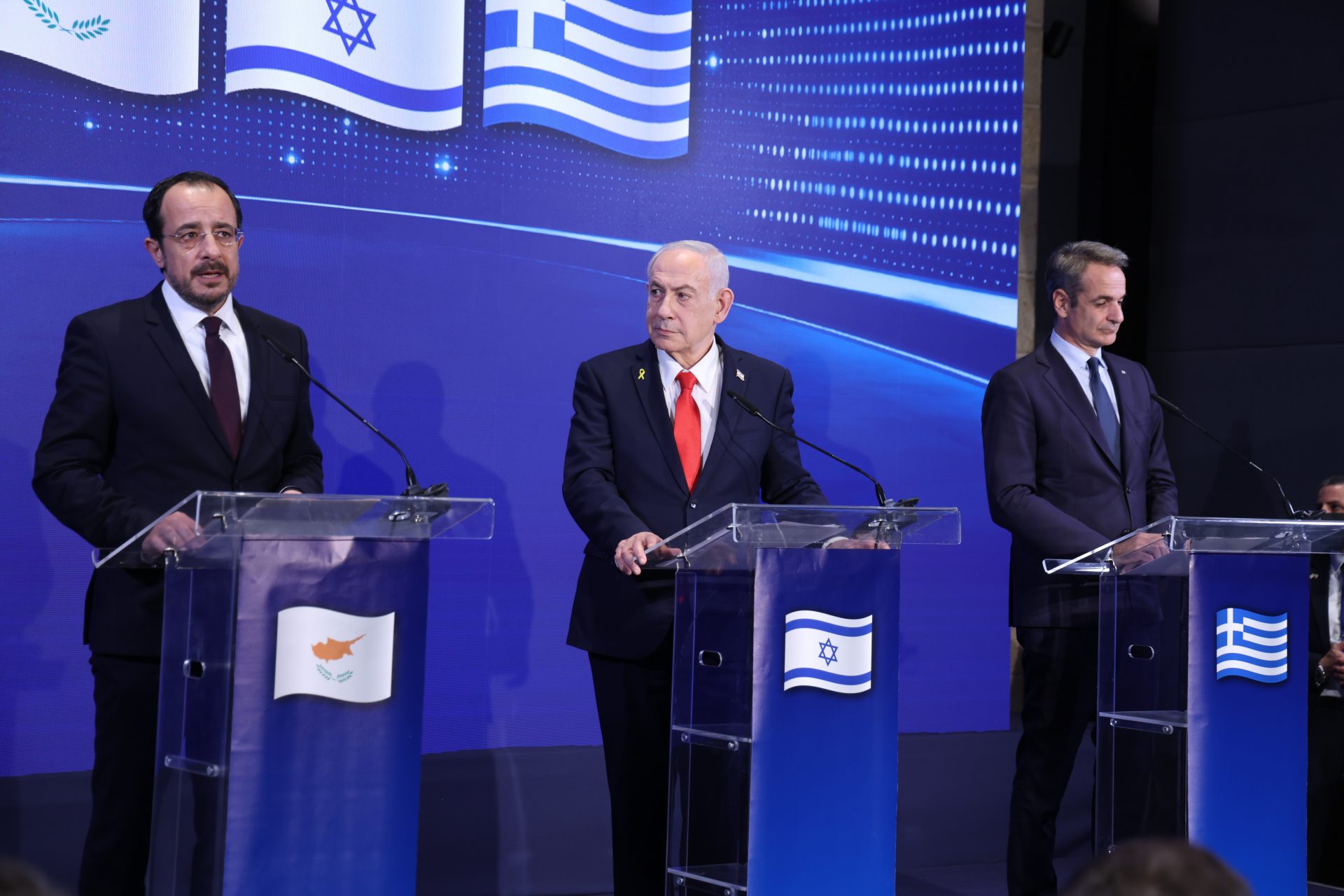
In official remarks published by the Cypriot Presidency, Nikos Christodoulides reaffirmed Cyprus's commitment to close coordination with Greece and Israel, presenting the trilateral framework as a cornerstone of stability, security, and economic cooperation in the Eastern Mediterranean.
Speaking alongside Greek Prime Minister Kyriakos Mitsotakis and Israeli Prime Minister Benjamin Netanyahu, Christodoulides emphasized that the partnership is grounded in shared values and mutual trust. He described the cooperation as mature and resilient, capable of responding collectively to regional challenges.
Trilateral Message from the Presidency
In the statement released on the official website of the Cypriot Presidency, Christodoulides underlined that Cyprus, Greece and Israel intend to further institutionalize cooperation in areas ranging from energy and infrastructure to security and technological innovation. He framed the trilateral format as a positive force designed to promote peace and prosperity rather than confrontation.
The emphasis on continuity and strategic depth was notable, with Christodoulides portraying the partnership as an established mechanism rather than an ad-hoc alignment shaped by short-term pressures.
Ankara's View: Stability Requires Inclusion
From Ankara's perspective, however, the official messaging reinforces long-standing concerns about exclusionary regional formats. Türkiye has consistently argued that Eastern Mediterranean stability cannot be achieved through selective partnerships that sideline major coastal actors.
Turkish officials maintain that energy cooperation, maritime arrangements, and regional security frameworks must be inclusive to be durable. In this view, trilateral mechanisms that exclude Türkiye risk entrenching divisions rather than fostering genuine stability.
Energy and Geopolitics Intersect
Energy cooperation featured prominently in the Cypriot president's remarks, reflecting the strategic weight of gas exploration, electricity interconnection, and infrastructure projects in trilateral planning. While Cyprus, Greece and Israel present these initiatives as economic and technical in nature, Ankara views them as deeply political.
Türkiye has repeatedly stressed that any long-term Eastern Mediterranean energy architecture must reflect geographic realities and the rights and interests of all communities, including Turkish Cypriots.
A Widening Diplomatic Gap
The contrast between the Cypriot presidency's official tone and Ankara's response highlights a widening diplomatic gap in the Eastern Mediterranean. While Christodoulides framed trilateral cooperation as stabilizing and value-based, Türkiye continues to see bloc politics as inherently limiting.
Ankara's position remains that lasting security and economic integration in the region will require dialogue formats that bring all key actors to the table rather than reinforcing parallel alliances.
Regional Takeaway
Christodoulides' official message leaves little doubt that Cyprus intends to deepen its alignment with Greece and Israel. For Türkiye, the statement underscores a familiar challenge: navigating a regional environment where cooperation is increasingly structured around exclusive partnerships, even as broader stability demands more inclusive engagement.