
By Bosphorus News Geopolitics Desk
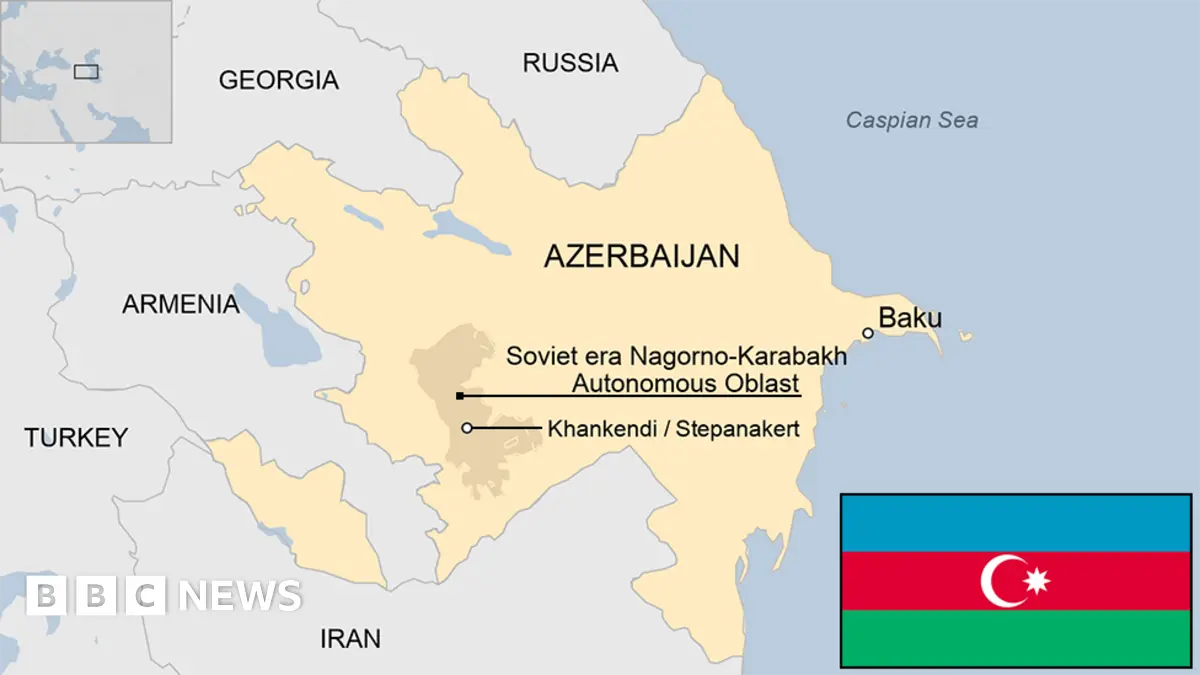
Azerbaijan has formally protested a Russian state television broadcast that showed a distorted map of Azerbaijan and used the phrase "Nagorno-Karabakh," reopening one of Baku's most sensitive sovereignty files at a time when relations with Moscow remain burdened by the unresolved AZAL crash case.
Azerbaijan's Ministry of Foreign Affairs said on May 8 that Russia's Channel One had displayed the map during the "Vremya Pokazhet" programme on May 6. Foreign Ministry spokesperson Aykhan Hajizada called the broadcast a "serious provocation" and "an unacceptable act of political manipulation."
The ministry said the map misrepresented Azerbaijan's internationally recognised territory and used terminology Baku considers legally and politically obsolete after Azerbaijan restored full control over Karabakh in September 2023.
"The sovereignty and territorial integrity of the Republic of Azerbaijan have been fully restored, and this reality is recognized by the international community, including the Russian Federation," Hajizada said.
He said the broadcast of "outdated, false, and separatism-promoting narratives" on a Russian state television channel contradicted the principles of mutual respect and good-neighbourly relations between Azerbaijan and Russia.
"Such irresponsible and biased conduct by a state-owned media outlet is unacceptable," Hajizada said.
Baku said it expected Russia to provide a clear explanation and to take steps to prevent similar incidents. Russian authorities had not issued a public response to the map incident at the time of publication.
The protest is not only about terminology. Since 2023, Azerbaijan has treated any separate political or geographic reference to "Nagorno-Karabakh" as a challenge to its restored sovereignty over the region. The fact that the phrase appeared on Russian state television gives the incident additional weight in Baku, where Moscow's role in the post-war South Caucasus remains closely watched.
The episode also lands against the background of the December 2024 Azerbaijan Airlines crash, which continues to hang over bilateral relations. The AZAL Embraer 190, operating flight J2-8243 from Baku to Grozny, crashed near Aktau in Kazakhstan on Dec. 25, 2024, killing 38 of the 67 people on board.
Baku has linked the crash to a Russian air-defence error and has continued to seek accountability from Moscow. Russian President Vladimir Putin apologised after the incident and said the aircraft had been damaged unintentionally, but Azerbaijan has kept the distinction between apology, insurance payments and state responsibility at the centre of its position.
That distinction remains politically important. Insurance compensation can address financial claims linked to the aircraft and victims, but it does not close the state-responsibility question that Baku has raised in relation to Russian military assets and the circumstances of the crash.
Azerbaijani officials have also criticised Russia's handling of the criminal investigation. Foreign Minister Jeyhun Bayramov was quoted in regional reporting as saying that the closure of the Russian criminal case caused "serious surprise" in Baku. Kazakhstan, where the aircraft went down, has been leading the technical investigation.
The Channel One map incident therefore adds another layer to a relationship that has stabilised on the surface but still contains unresolved pressure points. Azerbaijan continues to manage ties with Moscow, yet its public response shows that Karabakh terminology and the AZAL case remain red lines in Baku's diplomacy.
The timing also matters because Azerbaijan is widening its foreign policy and security profile elsewhere. Baku is working with NATO on defence education reform, pushing defence coordination inside the Organization of Turkic States and positioning itself as a Caspian energy bridge toward Europe. Those moves do not amount to a rupture with Russia, but they show that Azerbaijan is operating across several diplomatic tracks while defending its sovereignty narrative more sharply.
The map dispute is unlikely by itself to reshape Azerbaijan-Russia relations. Its significance lies in the issue it touched. Baku considers Karabakh's status closed, while the AZAL crash case remains politically unfinished. A Russian state media broadcast that revives old territorial language could not pass as a routine mistake in that climate.
***Sources: Azerbaijan Ministry of Foreign Affairs, May 8, 2026; AZERTAC, May 8, 2026; APA, May 8, 2026; Reuters and Associated Press reporting on the December 2024 AZAL crash; Kazakhstan Ministry of Transport investigation updates; regional reporting on Foreign Minister Jeyhun Bayramov's comments; Bosphorus News reporting.