
By Bosphorus News Energy Desk
A new Atlantic Council issue brief argues that Türkiye's gas strategy has moved well beyond simple supply security. Since the 2017 National Energy and Mining Policy, the report says, Ankara has shifted from heavy pipeline dependence toward a more flexible system built around liquefied natural gas, storage expansion, and domestic Black Sea production.
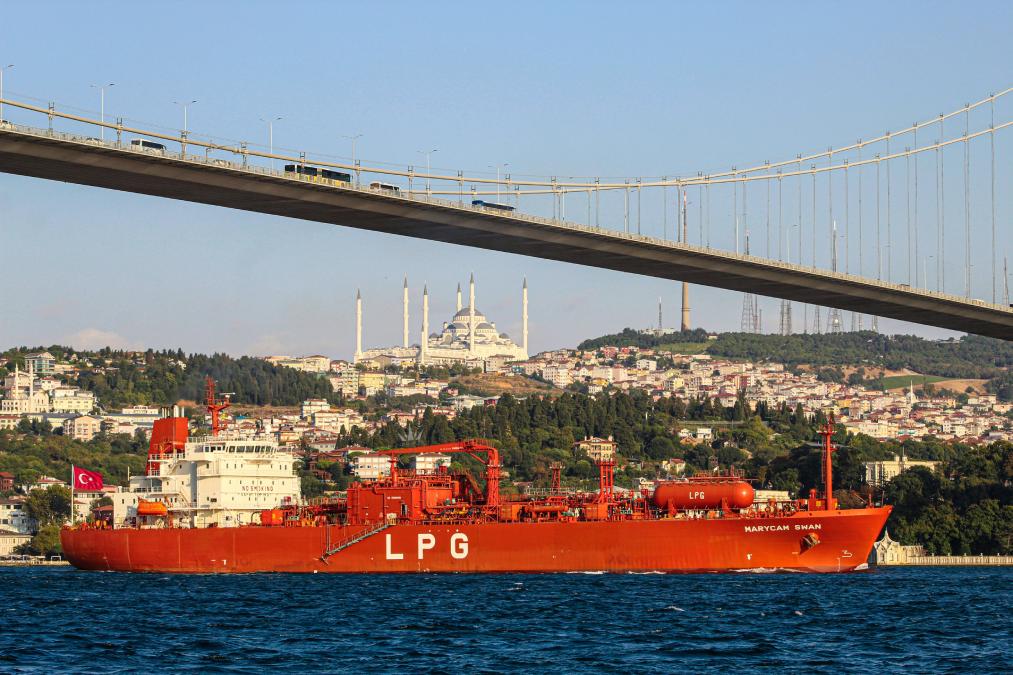
The clearest number in the report is the LNG infrastructure jump. It says Türkiye's regasification capacity rose about fivefold by 2025, reaching 150 million cubic meters per day, up from 37 million cubic meters before 2016. In the report's framing, that did not just provide a winter buffer. It gave BOTAŞ stronger bargaining power against traditional pipeline suppliers, especially Russia and Iran, by making spot and portfolio LNG a more credible substitute.
The brief also argues that the strategy is no longer confined to the domestic market. It says the Saros FSRU and expanded storage have helped connect Türkiye's grid more directly to Balkan markets, supporting exports to Bulgaria, Hungary, Romania, and Moldova. It highlights the 13-year Bulgargaz deal with transfer volumes of up to 1.5 bcm per year, and notes that Hungary became the first non-neighboring country to receive Turkish gas exports, with an initial volume of 275 mcm.
Another major pillar is the Sakarya gas field in the Black Sea. The report says reserves were first estimated at 540 bcm and later revised up to 710 bcm, with production targeted to reach 40 mcm per day, or about 15 bcm per year, by 2028. At that level, the brief says Sakarya could cover roughly 25 to 30 percent of Türkiye's current domestic gas consumption and materially improve Ankara's negotiating position in future supply talks.
The broader argument is geopolitical as much as commercial. The author says Türkiye is trying to move from being a transit country to becoming a regional trading hub where LNG imports, pipeline gas, and domestic output can be blended and redirected. If that trajectory holds, the report argues, Ankara's role in Southeastern Europe's energy security will deepen alongside its diplomatic leverage inside NATO and across the Balkans.
***Source: "Turkey's gas diversification strategy and rising share of LNG," by Eser Özdil, Atlantic Council, 3 March 2026.