
By Bosphorus News Geopolitics Desk
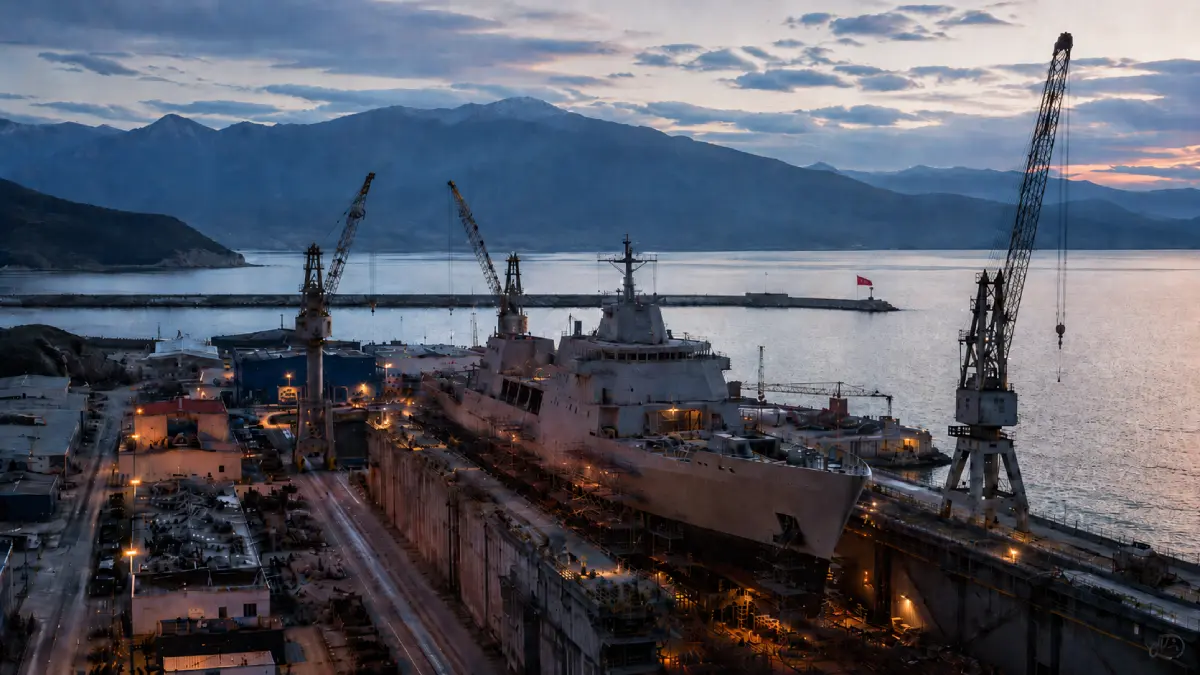
Albania is moving to turn the Pashaliman naval base near Vlorë into a North Atlantic Treaty Organization (NATO) aligned naval production hub, adding an Italian industrial layer to a site where Türkiye has maintained a defence role under a military cooperation framework dating back more than three decades.
The Türkiye connection gives the project wider strategic weight. Turkish Naval Forces personnel have provided advisory and training support at Pashaliman, and Turkish Defence Minister Yaşar Güler told parliament in January 2026 that Albania had made no official request to end Türkiye's presence at the base.
The new phase was formalised on April 29, when Italian shipbuilder Fincantieri and KAYO, the Albanian state-owned defence company controlled by the Ministry of Defence, signed a joint venture agreement in Tirana. The company will be 51 percent owned by Fincantieri and 49 percent by KAYO, with Pashaliman designated as the main production facility.
Fincantieri said the 2026-2030 industrial plan targets around ten offshore patrol vessels (OPVs), with production serving both the Albanian Armed Forces and international markets. The project is expected to create about 400 jobs at Pashaliman.
Rama and Nufi Put Industry at the Centre
Prime Minister Edi Rama presented the agreement as a step that reaches beyond the Albanian Navy.
"We have reached an important point for the future, not only for Albania's security apparatus and Armed Forces, but also for the economy and the future of Albania's youth," Rama said at the signing ceremony.
Rama said the first two vessels produced at Pashaliman would enter the Albanian fleet, bringing the total number of Albanian Navy ships to seven. He described that number as optimal for Albania's "strategic status and NATO" responsibilities.
Defence Minister Ermal Nufi tied the project directly to Albania's ambition to become a defence industrial actor, not only a buyer of foreign platforms.
"Albania will become a new European base for Fincantieri in the production of small and medium-sized vessels," Nufi said. "Today, with this signing, KAYO begins a new step where we will be able to produce for export needs."
Nufi's institutional background gives the project additional weight. Before becoming defence minister in March 2026, he chaired KAYO's board. In his first remarks after taking office, he listed the modernisation of the Armed Forces, the revitalisation of the military industry and full compliance with NATO standards among his main priorities.
Fincantieri Adds the Industrial Layer
Fincantieri framed the deal as part of a wider strategic partnership between Rome and Tirana.
Pierroberto Folgiero, the company's chief executive, called the agreement "a milestone in Italian-Albanian strategic cooperation," saying it confirmed the strength of a partnership built on "shared interests and a long-term vision."
The Italian Embassy in Tirana described the agreement as one of the most important Italian investments in Albania. The April 29 joint venture followed two earlier memoranda of understanding: one signed in Durrës in April 2025 in the presence of Italian Defence Minister Guido Crosetto, Rama and then Defence Minister Pirro Vengu, and another signed in Rome in November 2025 during an Italy-Albania intergovernmental meeting.
The production site is the key point. Pashaliman is being placed inside a shipbuilding plan tied to patrol vessels, export markets, workforce expansion and Albania's attempt to revive a domestic defence industry under NATO standards.
Pashaliman's Older Strategic Layer
Pashaliman's weight predates Albania's NATO membership. The base near Vlorë served as the Soviet Union's only Mediterranean submarine facility in the 1950s, before Albania broke with Moscow in 1961 and took control of the site.
After the collapse of communism, Albania and Türkiye built a new defence relationship around the base. Under the 1992 Türkiye-Albania bilateral military cooperation framework, Türkiye helped rebuild Pashaliman and gained use of the facility for Turkish Navy activity in the Ionian and Adriatic seas.
That history now sits behind the Italian-Albanian shipbuilding plan. Turkish Naval Forces personnel have provided advisory and training support at the base, while Ankara's wider defence relationship with Tirana has continued through training, logistics, financial support and equipment cooperation.
Türkiye and Albania signed a Financial Assistance Protocol in July 2025, including the provision of 105 mm artillery systems. In December 2025, Türkiye also donated an Airbus A319-115J aircraft to the Albanian Armed Forces under an agreement valued at $11.9 million.
Türkiye Says Its Pashaliman Role Remains
Güler addressed speculation in January 2026 that the Fincantieri-KAYO framework could push Türkiye out of Pashaliman.
"No official request has been received from Albania for the termination of Türkiye's presence at Pashaliman," Güler wrote in parliamentary correspondence. "Allegations in this direction are completely unfounded."
Güler said Turkish Naval Forces personnel continued to provide advisory and training support at the base. He also described the Fincantieri-KAYO agreement as "independent in nature" from Türkiye's role and said it did not weaken Ankara's position. The Turkish side, he added, would evaluate "effective and multilateral working models" that could further strengthen Türkiye's contribution to security in the Adriatic and Ionian seas.
Ankara's position keeps the story away from a clean replacement narrative. Italy is bringing the new industrial project. Albania controls the facility and the production agenda. Türkiye says its defence role continues under an older bilateral framework.
NATO Watches the Adriatic-Ionian Theatre
Albania's Pashaliman move comes as Tirana deepens its NATO modernisation agenda across multiple tracks.
Nufi met NATO Secretary General Mark Rutte in Brussels on April 14. Two days later, he met General Giuseppe Cavo Dragone, Chair of the NATO Military Committee, with discussions focused on Western Balkans security, NATO's Kosovo Force (KFOR), Corridor VIII infrastructure and the planned Porto Romano military port in Durrës.
On May 13, Admiral Stuart Wikoff, Commander of NATO Allied Joint Force Command Naples (JFC Naples), visited Tirana for talks with Nufi. The Albanian Ministry of Defence said the two sides discussed modernisation priorities and warned that the region "remains exposed and vulnerable to disinformation, hybrid threats and cyberattacks," requiring sustained attention, close coordination and constant vigilance among allies.
The same NATO southern flank environment was visible in Serbia-NATO Exercise 2026, where Türkiye joined Serbia, Italy and Romania in Serbia's first joint military exercise with NATO, placing Balkan security and allied coordination in the same regional frame.
Albania has also moved to meet NATO burden-sharing expectations. Its defence budget reached about 2.12 percent of gross domestic product (GDP) in 2026, passing the alliance's 2 percent benchmark. Nufi has said Albania will begin contributing financially to selected NATO activities from 2026.
The Pashaliman project also sits inside the wider Western Balkans track, where EU integration, NATO readiness and resilience against hybrid threats are increasingly treated as connected files, an issue Bosphorus News examined in its coverage of gradual Western Balkans integration.
A Layered NATO Base Story
Pashaliman's new phase brings several strategic lines into the same location.
Albania is using the base to build naval production capacity and revive its defence industry. Fincantieri is turning Pashaliman into an Italian-Albanian shipbuilding platform with export ambitions. Türkiye is holding to a defence role rooted in the 1992 military cooperation framework. NATO's regional command structure is reading the Adriatic-Ionian theatre through modernisation, hybrid threats, infrastructure and allied readiness.
That combination gives Pashaliman its renewed strategic weight. A former Cold War submarine base is becoming a patrol vessel production site, an industrial test case for Albania, a strategic investment for Italy and a continuing point of reference for Türkiye's Adriatic-Ionian presence. In the Western Balkans, where maritime access, defence industry and alliance coordination increasingly overlap, Pashaliman is returning to the map as more than an old naval base.
***Sources: Albanian Prime Minister's Office, Albanian Ministry of Defence, Fincantieri official press release, Italian Embassy in Tirana, Reuters, NATO, NATO Allied Joint Force Command Naples, Turkish Ministry of National Defence parliamentary correspondence, Türkiye-Albania defence cooperation documents, Anadolu Agency, Bosphorus News reporting.