
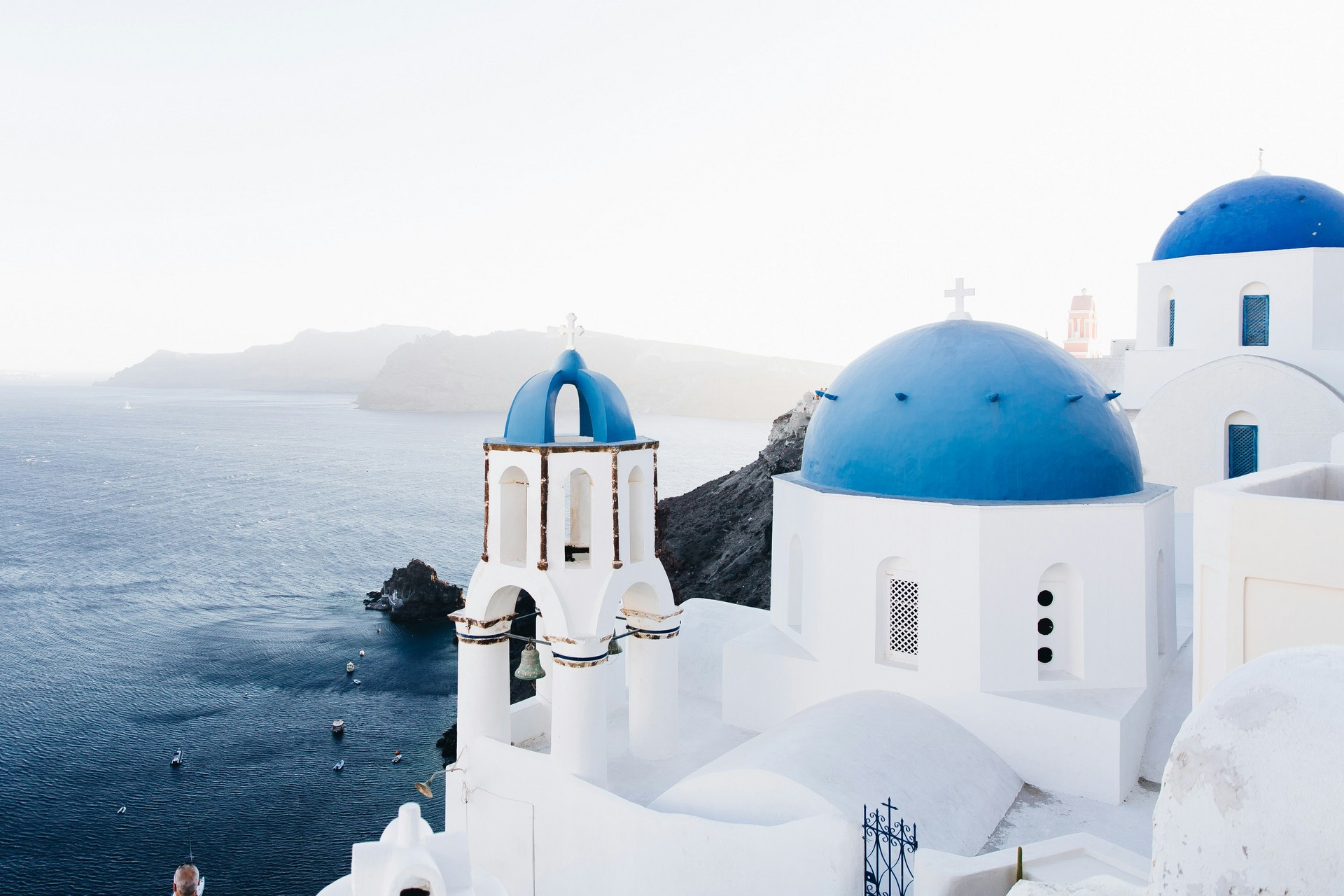
In early 2025, the Greek island of Santorini and its surroundings were rattled by an intense swarm of more than 28,000 earthquakes, some exceeding magnitude 5.0, sparking concern among residents and scientists.
A groundbreaking new study, conducted by an international team including the GFZ Helmholtz Centre for Geosciences and GEOMAR Helmholtz Centre for Ocean Research Kiel, has now revealed that the quakes were not just tectonic — they were driven by magma rising deep beneath the Aegean Sea.
Mapping Magma with AI and Seafloor Sensors
Using a sophisticated AI-supported method to process seismic data, researchers traced the path of the magma ascent with high precision.
They combined data from land-based seismometers, seafloor sensors located near the submarine volcano Kolumbo (just 7 km from Santorini), satellite radar (InSAR), and GPS instruments.
Their analysis suggests that around 0.31 cubic kilometers of magma (about 300 million cubic meters) rose from a mid-crustal source beneath Kolumbo.
Rather than erupting, the magma stalled roughly 4 kilometers below the seafloor, breaking and fracturing the rock around it — in the process triggering the massive earthquake swarm.
One of the most striking findings is evidence of a hydraulic connection between the nearby volcanic systems of Santorini and Kolumbo. The study's models show that as the dike of magma moved upward, both volcanoes exhibited changes in deformation: Santorini's ground subsided, while Kolumbo's reservoir appeared to shrink.
This supports a vision of a coupled magmatic system, where magma can migrate between reservoirs previously thought to be isolated.
Timeline of the Crisis
- Mid-2024: The crisis began much earlier than the quakes, as satellite and GPS data detected a gradual uplift in Santorini's caldera, paired with increases in gas emissions (CO₂, H₂), pointing to fresh magma accumulation.
- January 2025: Seismic activity intensified. The AI-mapped quakes moved in pulses from ~18 km depth up to ~3–4 km beneath the seafloor.
- February 2025: After peaking, the seismic crisis subsided, but ongoing monitoring continues, with GEOMAR still operating multiple seafloor sensor platforms.
Scientific and Safety Implications
The study provides a rare and detailed window into how magma moves beneath volcanic islands, offering critical insight into volcanic risk. According to one of the lead researchers, tracing magma paths in real time helps improve early warning and risk management for both Santorini and Kolumbo.
Indeed, previous expert commentary had already flagged the swarm as volcanic in nature. Professor Costas Synolakis, a respected geophysicist, told Greek media that the earthquake activity was consistent with magma migration, not just tectonic faulting.
Broader Context
Scientists note that Santorini sits on the Hellenic Volcanic Arc, one of Europe's most active volcanic zones. SciTechDaily
Kolumbo itself is a well-known submarine volcano located only a few kilometers from Santorini, and historical data suggest potential links between their magmatic systems.
Turkey's disaster agency (AFAD) has also issued warnings in the past, noting that frequent seismic activity in the Aegean Sea could raise the risk of volcanic activity — underscoring the importance of studies like this.
***Credit: Based on reporting from SciTechDaily (original by the GEOMAR / GFZ research team).