
By Bosphorus News Staff
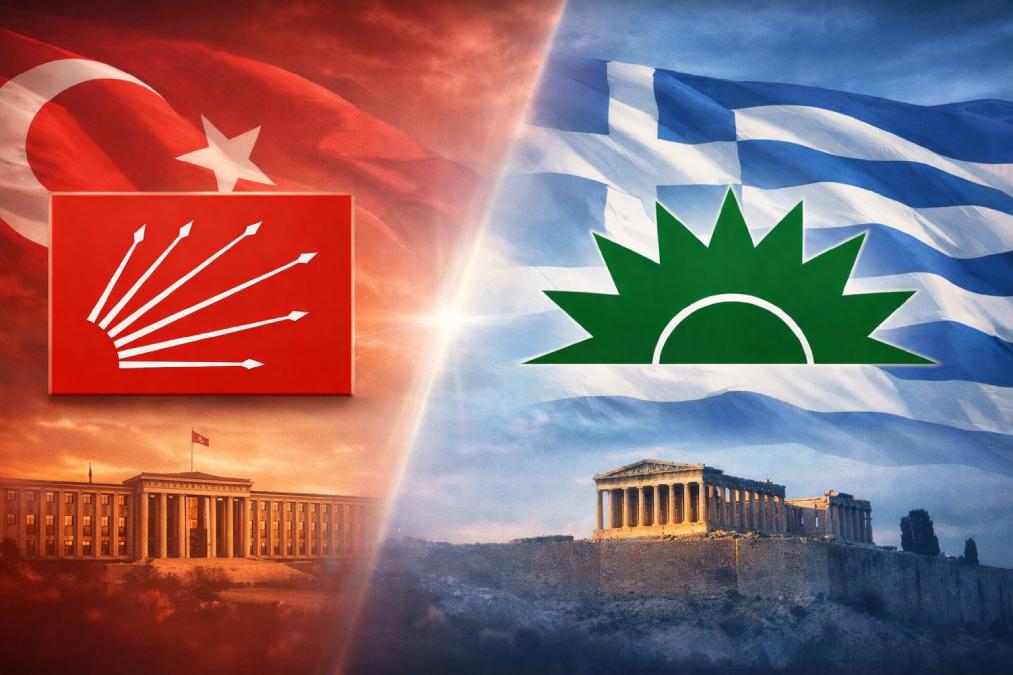
A newly published academic study in Mediterranean Politics examines Türkiye's Republican People's Party (CHP) and Greece's Panhellenic Socialist Movement (PASOK) as parallel cases of centre left parties navigating long term decline, political realignment, and changing voter coalitions in Southern Europe.
The study places both parties within a broader crisis of social democracy shaped by economic restructuring, electoral volatility, and the erosion of mass party organisation. It argues that neither CHP nor PASOK weakened primarily because of ideological exhaustion. Instead, the authors point to organisational rigidity, the loss of durable social anchoring, and persistent difficulty in adapting to post crisis political competition.
In the Greek case, PASOK's sharp collapse during the eurozone debt crisis is described as a decisive rupture that dismantled its historical role as a governing party. Its more recent electoral stabilisation is presented as a limited recovery rather than a return to dominance. According to the study, this stabilisation reflects leadership renewal and organisational recalibration aimed at restoring credibility within a narrower political space.
CHP, by contrast, is portrayed as a party that avoided systemic collapse and retained electoral relevance, yet struggled to convert this position into governing power. The study highlights CHP's reliance on broad opposition alliances, noting that while this strategy widened its electoral reach, it also constrained programmatic clarity and postponed deeper organisational renewal.
A central comparative finding is that the two parties followed contrasting adaptation paths. PASOK contracted in size while pursuing internal consolidation, whereas CHP expanded electorally while remaining organisationally stretched. In both cases, the authors argue, the traditional mass party model was not reconstructed. Instead, each party adapted to leaner, campaign centred structures with limited societal penetration.
The study concludes that the future capacity of social democratic parties in both Türkiye and Greece will depend less on rhetorical repositioning and more on organisational reform, leadership credibility, and the ability to reconnect with fragmented middle and working class constituencies under new economic and political conditions.
***Source: Şenol Arslantaş and Düzgün Arslantaş, Social democracy between decline and resilience: PASOK and CHP in comparative perspective, Mediterranean Politics (2026).
All arguments and findings belong to the authors. Bosphorus News provides a journalistic summary for informational purposes.